

The 2027 Nigeria presidential election is already taking shape around three major political tickets: President Bola Tinubu and Vice President Kashim Shettima of the All Progressives Congress (APC); Peter Obi and Rabiu Kwankwaso of the Nigeria Democratic Congress (NDC); and former Vice President Atiku Abubakar and Rotimi Amaechi of the African Democratic Congress (ADC).
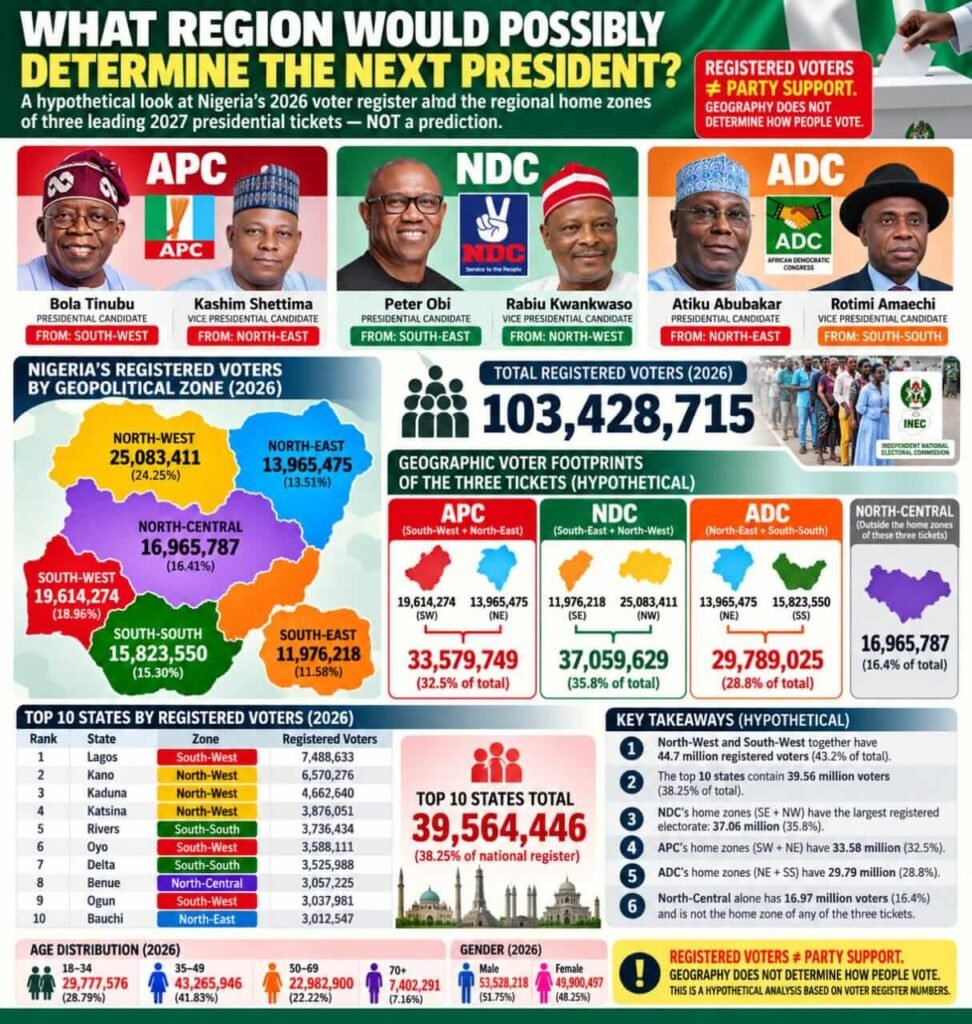
With the Independent National Electoral Commission (INEC) putting Nigeria’s 2026 voter register at 103,428,715 registered voters, the figures provide a useful basis for examining the geographical distribution of the electorate ahead of the 2027 presidential election.
This is not a prediction of the election outcome. Rather, it is an examination of what the size and geographical distribution of Nigeria’s registered electorate could mean for the three leading presidential tickets.
INEC has published the final list of presidential candidates and their running mates for the 2027 election, including the Tinubu-Shettima, Obi-Kwankwaso and Atiku-Amaechi tickets.

NDC’s Peter Obi could be the suprise package in the 2027 Nigeria Presidential election
North-West, South-West dominate Nigeria’s voter register
| Geopolitical zone | Registered voters | Approx. share |
|---|---|---|
| North-West | 25,083,411 | 24.25% |
| South-West | 19,614,274 | 18.96% |
| North-Central | 16,965,787 | 16.40% |
| South-South | 15,823,550 | 15.30% |
| North-East | ~13.97m | ~13.51% |
| South-East | ~11.98m | ~11.58% |
| Total | 103,428,715 | 100% |
2027 Nigeria Presidential Election: Voter register favours Tinubu, Atiku
The first striking feature of the 2027 electoral map is the concentration of registered voters across Nigeria’s six geopolitical zones.
The North-West has the largest number of registered voters, with 25,083,411, representing about 24.25 per cent of the national register. The South-West follows with 19,614,274, or approximately 18.96 per cent.
Alhaji Atiku Abubakar of the ADC could benefit from the Northwest voters strength
The North-Central has 16,965,787 registered voters, while the South-South accounts for 15,823,550.
The North-East and South-East have smaller voter registers, with approximately 13.97 million and 11.98 million registered voters respectively.
Combined, the North-West and South-West have about 44.7 million registered voters, representing roughly 43.2 per cent of Nigeria’s entire voter register.
That makes the two zones particularly important in any numerical assessment of the 2027 presidential contest.
Tinubu, Obi and Atiku tickets: What their regional footprints show
When the three leading tickets are placed against the six-zone voter map, an interesting picture emerges.
President Bola Tinubu is from the South-West, while his running mate, Kashim Shettima, is from the North-East. The APC ticket therefore has geographical links to zones with a combined electorate of about 33.58 million registered voters.
For the NDC, Peter Obi comes from the South-East and Rabiu Kwankwaso from the North-West. Their combined home-zone electorate is approximately 37.06 million registered voters, the largest of the three tickets.
The ADC ticket of Atiku Abubakar and Rotimi Amaechi draws from the North-East and South-South respectively, giving the ticket a combined home-zone electorate of about 29.79 million registered voters.
The figures, however, must be treated carefully.
They do not represent party support or projected votes. They simply show the number of registered voters in the geopolitical zones associated with the candidates on each ticket.
A registered voter in Lagos is not automatically an APC voter because Tinubu is from the South-West. In the same way, a registered voter in Kano is not automatically an NDC supporter because Kwankwaso is from the North-West.
The voter register tells us where registered voters are located, not how they will vote.
Lagos, Kano, Kaduna lead Nigeria’s biggest voting states
The state-by-state figures make the electoral picture even more compelling.
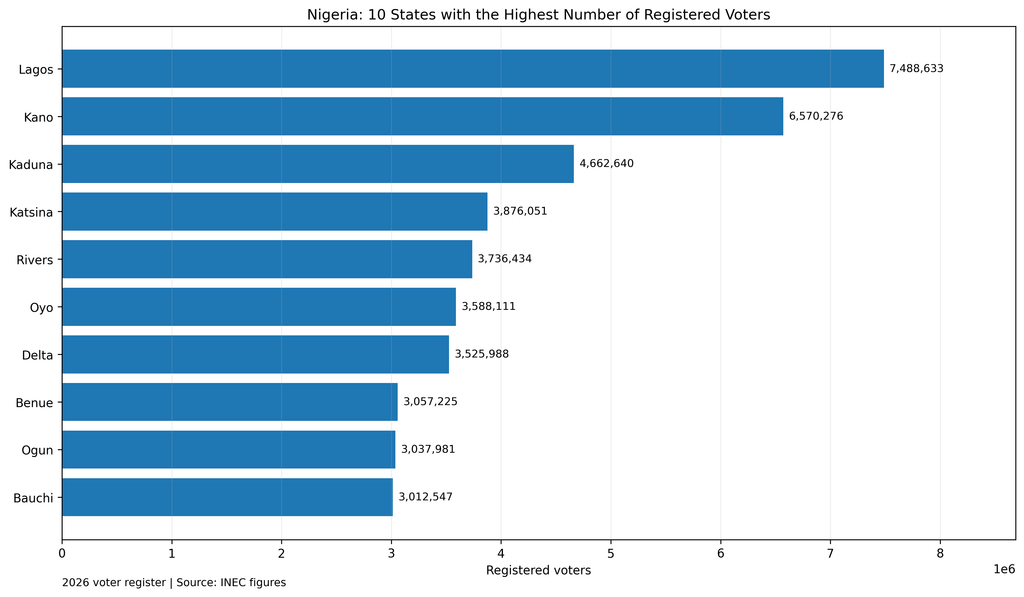
Lagos has the largest number of registered voters, with about 7.49 million, followed by Kano with approximately 6.57 million and Kaduna with about 4.66 million.
They are followed by Katsina with 3.88 million, Rivers with 3.74 million, Oyo with 3.59 million, Delta with 3.53 million, Benue with 3.06 million, Ogun with 3.04 million and Bauchi with about 3.01 million.
Together, the 10 states account for approximately 39.56 million registered voters, representing more than 38 per cent of the national register.
The concentration of these high-registration states is also significant.
Three — Kano, Kaduna and Katsina — are in the North-West. Three — Lagos, Oyo and Ogun — are in the South-West. Rivers and Delta are in the South-South, while Benue is in the North-Central and Bauchi is in the North-East.
There is no South-East state among the 10 states with the largest voter registers.
Why the North-West could be crucial in 2027
The North-West stands out because it has Nigeria’s largest geopolitical voter register.
With more than 25 million registered voters, the zone represents nearly one-quarter of the national electorate. Kano, Kaduna and Katsina alone rank among the 10 states with the largest voter registers.
The political significance of the zone is therefore difficult to overlook as the major parties and presidential candidates build their campaigns.
The NDC ticket has a particularly direct connection to the region through Kwankwaso, a former governor of Kano State and a major political figure in the North-West.
But the size of the register does not automatically translate into electoral advantage.
Turnout, voter preferences, party organisation, campaign strength, local political dynamics and the ability of candidates to win votes across other regions will ultimately matter more than the number of people registered.
South-West remains another major electoral battleground
The South-West is the second-largest voting bloc, with more than 19.6 million registered voters.
Lagos, Nigeria’s most populous state and the state with the largest voter register, is located in the zone, alongside Oyo and Ogun, which also feature among the country’s 10 largest voter registers.
The region therefore combines a large electorate with several strategically important states.
For the APC, the South-West is also President Tinubu’s home region. However, as with the North-West, the size of the register should not be confused with guaranteed votes.
The 2027 presidential race will ultimately be determined by ballots cast, not simply by the geographical origins of the candidates.
North-Central could be the swing region
One of the most notable features of the electoral map is the position of the North-Central.
The zone has nearly 17 million registered voters, yet none of the three major tickets has both its presidential and vice-presidential candidates originating from the region.
This gives the North-Central considerable potential importance in a closely fought presidential election.
Benue, one of the country’s 10 largest states by voter registration, is also located in the zone.
The region’s electoral importance may therefore extend beyond its population of registered voters. Its ability to provide votes to candidates seeking the constitutionally required spread could make it a significant battleground.
Under Nigeria’s presidential election rules, a candidate must secure the highest number of votes and at least one-quarter of the votes cast in at least two-thirds of the states and the Federal Capital Territory.
Registered voters are not the same as actual voters
Perhaps the biggest caution in analysing the 2027 voter register is turnout.
Nigeria may have more than 103 million registered voters, but registration alone does not guarantee that those voters will participate on election day.
The difference between registered voters and actual votes cast can be substantial. This means that the 2027 presidential election will not simply be a contest over which candidate has the largest geographical voter base.
It will also be a contest over mobilisation, turnout and voter conversion.
Candidates will have to persuade registered voters to obtain and use their Permanent Voter Cards, turn out on election day and cast their ballots.
So, which region could determine Nigeria’s next president?
On the basis of voter registration figures alone, the North-West and South-West immediately stand out.
Together, the two zones account for more than 44 million registered voters, or roughly 43 per cent of the national register.
But that does not make either region a guaranteed electoral stronghold for any candidate.
The North-Central, with nearly 17 million registered voters, also commands significant electoral weight. The South-South, North-East and South-East remain important blocs that could determine the national spread required to win the presidency.
The 2027 electoral map, therefore, provides a starting point — not a verdict.
The numbers show where Nigeria’s largest concentrations of registered voters are located. They do not reveal how those voters will behave at the ballot box.
As the 2027 presidential election approaches, the decisive question may not simply be where Nigeria’s voters are, but which candidates can turn the country’s enormous registered electorate into actual votes across enough states to win the presidency.
