

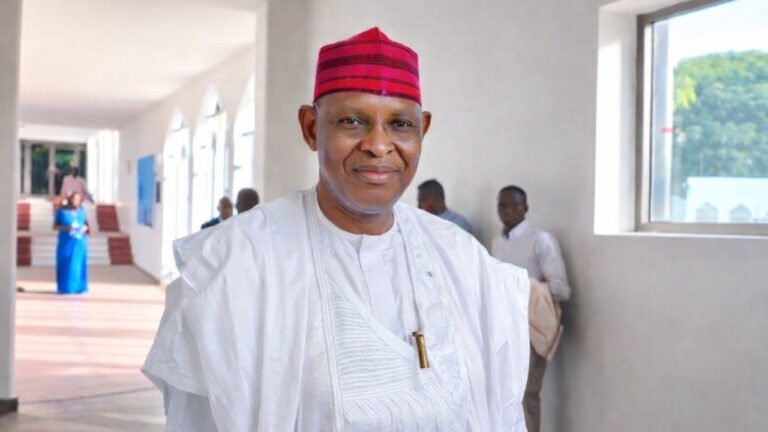
Photo: Gov Abba Yusuf – took Kano from NNPP to APC
By Austin Manekator
Nigeria may still be two years away from its next general elections, but the battle for 2027 has already begun in earnest. Across the country, the political atmosphere is thick with calculation, quiet negotiations, and strategic repositioning. At the heart of this early manoeuvring is a wave of gubernatorial defections that is steadily reshaping Nigeria’s political map long before the first ballot is cast.
In the past year, more than a dozen serving governors have either defected or openly aligned with the ruling All Progressives Congress from opposition parties such as the Peoples Democratic Party and the New Nigeria Peoples Party. These moves are not happening in a vacuum. They signal a deeper struggle over power, access, and relevance in a political system where timing is often as important as popularity.
While defections are a familiar feature of Nigerian politics, the scale and timing of the current trend make it particularly significant. This is not an election-season rush driven by panic. It is a carefully staged realignment aimed at shaping the battlefield well ahead of 2027. For many governors, changing parties now is less about ideology and more about securing a seat at the table where decisions about the future will be made.
Among the most talked-about defections are those of Douye Diri of Bayelsa State and Caleb Mutfwang of Plateau State, both elected on the platform of the PDP, as well as Abba Kabir Yusuf of Kano State, whose move from the NNPP to the APC carries enormous symbolic and electoral weight. Kano remains one of Nigeria’s most influential voting blocs, and any shift there sends ripples far beyond the state’s borders.
A clear pattern has emerged. The majority of defections have been from the PDP to the APC, reinforcing the perception of a ruling party steadily tightening its grip on the political system. The NNPP’s loss of Kano stands out as the most consequential non-PDP defection, weakening a party that had positioned itself as a regional force in the North-West. Geographically, the defections cut across the South-South, North-Central, and North-West, underscoring the national character of the realignment.
These movements matter because governors are not just ceremonial party members. They control vast political machinery at the state level, including local government structures, state assemblies, and grassroots networks. When a governor defects, lawmakers, commissioners, and party officials often follow, hollowing out the opposition from within and transferring institutional strength to the ruling party.
Several motivations drive these defections, and access to federal power sits at the top of the list. Nigeria operates a highly centralised system where federal approval, funding, and cooperation are critical to state-level governance. Governors in opposition frequently complain of being marginalised in project approvals, security coordination, and fiscal negotiations. Aligning with the ruling party is often presented as a practical decision taken in the interest of development rather than politics.
Internal crises within opposition parties have further accelerated the trend. The PDP, in particular, has struggled with leadership disputes, unresolved congresses, and factional rivalries that leave governors politically exposed. For many of them, remaining in a divided party with no clear roadmap to 2027 appears riskier than crossing over early to negotiate relevance within the dominant coalition.
Electoral strategy also plays a decisive role. Governors understand that elections are not won in the final months alone. They are won through years of groundwork, alliance-building, and positioning. Defecting early allows governors to secure guarantees for their political allies, influence party structures, and shape candidate selection processes well ahead of primaries. As one defecting governor put it during a rally, the move was taken to “protect the political future of our state in a rapidly changing national environment.”
Beyond individual decisions lies a broader process of political realignment. Realignment goes beyond defections to include coalition-building, regional bargaining, and strategic silence where necessary. The APC now controls roughly 29 of Nigeria’s 36 governorships, giving it unmatched dominance at the sub-national level. This translates into control over policy direction, electoral logistics, and political narratives across much of the country.
For opposition parties, the consequences are stark. The PDP faces declining territorial control and mounting questions about its ability to remain a viable national alternative. The Labour Party, despite its strong showing in the last election cycle, lacks the institutional depth and state-level infrastructure needed to immediately benefit from the opposition vacuum. APGA remains largely regional, while the NNPP’s influence has been significantly weakened by recent developments.
Still, dominance does not automatically guarantee victory. Nigerian voters have increasingly shown a willingness to distinguish between parties and candidates, particularly in urban areas and among younger voters. Internal tensions within the APC may also intensify as defectors compete with long-standing members for influence and nominations. Managing a coalition built on political convenience is often as challenging as constructing one.
As 2027 approaches, these shifts will shape voter perception in complex ways. The ruling party’s expanding reach may project strength and inevitability, but it also risks reinforcing public frustration with ideological fluidity and political opportunism. For many citizens, repeated defections deepen cynicism about a political class perceived as prioritising self-preservation over principles.
The implications will cut across presidential, gubernatorial, and legislative contests. Governors remain critical power brokers in mobilising votes, funding campaigns, and coordinating election-day logistics. Their early alignment with the ruling party gives the APC a structural advantage, even as opposition parties search for pockets where local sentiment and strong candidates can still challenge the tide.
In the end, Nigeria’s evolving political landscape reflects a system in constant motion. The current wave of defections is not an accident of ambition, but a calculated response to power dynamics that reward early positioning. Governors are not waiting for 2027 to arrive. They are shaping it now.
As the country inches toward its next general elections, the message is clear. Party labels may change, alliances may shift, and loyalties may be renegotiated, but the struggle for dominance is already well underway. Nigeria’s political map is being redrawn quietly, deliberately, and one governor at a time.
