


Thousands of Nigerians living and working in the United Kingdom may have to reconsider their plans for permanent residence following a major immigration policy announcement by the British government on November 2, 2026.
The UK government has unveiled a new immigration settlement framework known as Earned Settlement, which significantly changes how migrants qualify for Indefinite Leave to Remain (ILR), the immigration status that allows eligible individuals to live permanently in Britain without time restrictions.
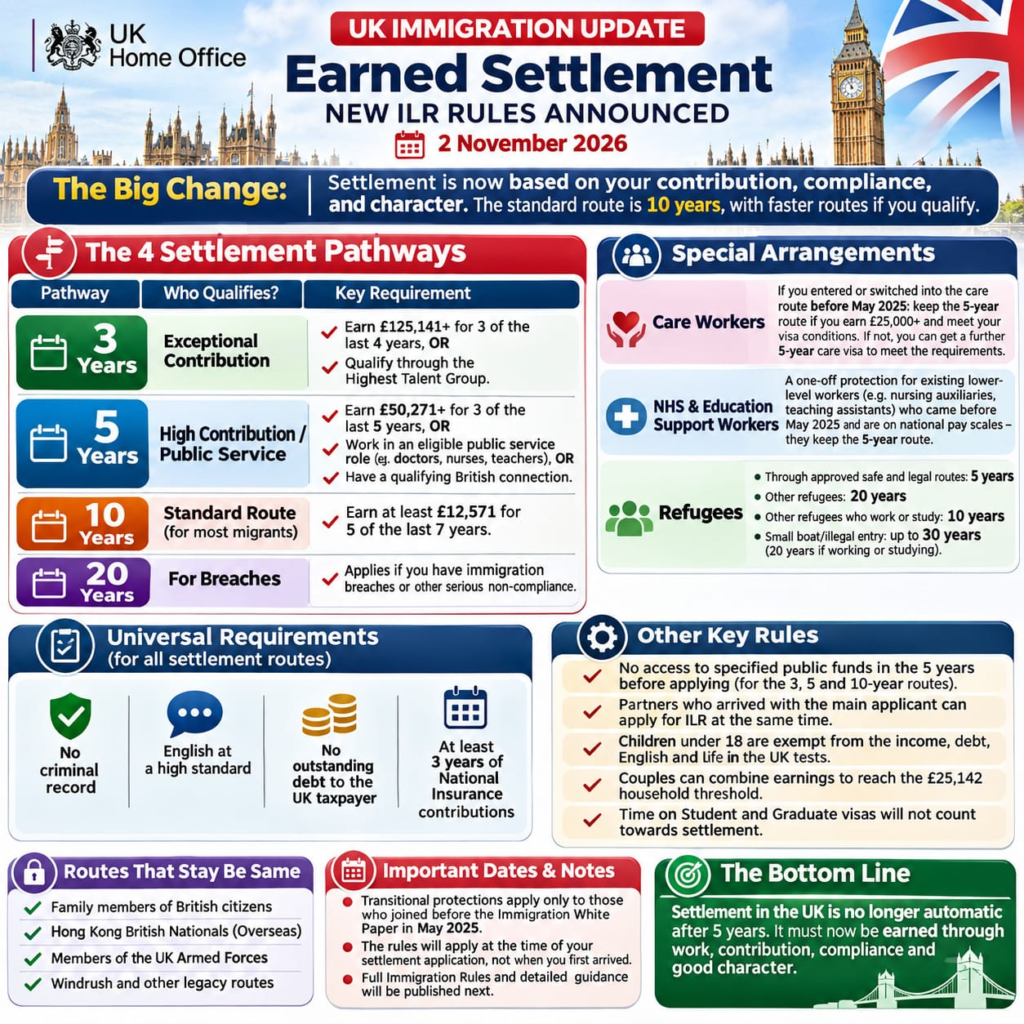
Under the new policy, the standard qualifying period for settlement will increase from five to ten years for most migrants. However, certain categories of workers and high earners will retain access to faster settlement routes after three or five years.
The new framework will assess migrants based not only on how long they have lived in Britain but also on their earnings, economic contribution, occupation, immigration history and compliance with visa conditions.
In practical terms, completing five years in the UK will no longer automatically make most migrants eligible for permanent residence.
Here is what the new UK settlement policy means for Nigerians and other foreign nationals.
UK EARNED SETTLEMENT: THE FOUR MAIN PATHWAYS
The government’s new framework establishes four main settlement periods: three, five, ten and twenty years.
1. Three years: Highest earners and exceptional talent
The fastest settlement route will be available to the UK’s highest earners and individuals admitted through designated exceptional talent schemes.
Under the detailed policy framework, migrants earning at least £125,141 within the qualifying earnings period may become eligible for settlement after three years, subject to the applicable conditions.
People entering Britain through the highest talent immigration schemes will also qualify for this accelerated pathway.
2. Five years: Higher earners and eligible public-service workers
The five-year settlement route will remain available to certain higher earners and workers making significant contributions to essential public services.
Migrants earning at least £50,271 in three of the five years immediately preceding their application may qualify under the higher-earner provision.
Eligible public-service professionals, particularly those working in healthcare and education, will also retain access to the five-year pathway.
These include qualifying doctors, nurses and teachers.
Certain individuals with qualifying British connections will also retain their existing settlement pathways.
3. Ten years: The standard settlement route
The ten-year period will become the standard qualifying period for most migrants who do not meet the requirements for the accelerated three- or five-year routes.
Applicants will need to demonstrate sustained economic contribution and satisfy the government’s mandatory settlement requirements.
The detailed framework includes an earnings requirement of at least £12,571 in five of the seven years immediately preceding an application.
Migrants who do not qualify for the faster routes will generally be expected to complete ten years before applying for Indefinite Leave to Remain.
4. Twenty years: Immigration breaches and non-compliance
Migrants who commit qualifying immigration breaches may face a settlement waiting period of at least twenty years.
The government has also introduced restrictions relating to access to specified public funds. Applicants who have claimed benefits must generally complete five continuous years without relying on those benefits before applying for settlement.
The applicable conditions and exemptions will determine how these provisions affect individual applicants.
SPECIAL PROTECTION FOR CARE WORKERS
One of the most significant concessions in the government’s announcement concerns foreign nationals working in the UK’s social care sector.
Following concerns about the impact of the proposed immigration reforms on existing care workers, the government has confirmed that certain workers will retain their existing five-year settlement pathway.
Care workers who entered or switched to the social care visa route before the publication of the Immigration White Paper in May 2025 may qualify for this protection if they complied with their visa conditions and earned at least £25,000 annually while working in the sector.
Those who meet these requirements will be allowed to apply for settlement under the existing five-year route.
However, workers who failed to meet their visa conditions will not automatically lose the opportunity to remain in Britain.
The government has announced that eligible affected workers will be offered another five-year care visa. This will give them an opportunity to find legitimate employment, including freedom from being tied to their previous employer, and work towards meeting the requirements for settlement.
Similar transitional arrangements will apply to certain public-service workers in healthcare and education whose roles have been identified by the Migration Advisory Committee. These include auxiliary nurses.
It is important to understand that these protections are not available to everyone working in care, healthcare or education. The date of entry into the relevant immigration route, occupation, earnings and compliance with visa conditions will determine eligibility.
WHAT OTHER REQUIREMENTS MUST MIGRANTS MEET?
Beyond the qualifying residence periods, the Earned Settlement framework introduces mandatory requirements that applicants must satisfy before obtaining permanent residence.
The government has identified four fundamental conditions:
1. Criminal record: Applicants must meet the new criminality requirements, which are stricter than the previous settlement standard.
2. English language: Migrants will be required to demonstrate a higher standard of English proficiency.
3. Government debts: Applicants must not have outstanding debts owed to the British taxpayer, subject to applicable rules and exemptions.
4. National Insurance contributions: Applicants must demonstrate a record of sustained National Insurance contributions, including at least three years of contributions.
Applicants must also satisfy the applicable Life in the UK Test requirement.
The government has further confirmed that migrants who have claimed specified public benefits must complete five continuous years without relying on those benefits before applying for settlement, subject to any applicable exemptions.
These requirements mean that simply completing the required number of years in Britain will not be sufficient. Applicants must also demonstrate that they have met the government’s expectations concerning character, integration and economic contribution.
WHAT DOES THE NEW UK SETTLEMENT POLICY MEAN FOR FAMILIES, STUDENTS AND REFUGEES?
The Earned Settlement reforms also have implications for migrants arriving through family, education and humanitarian routes.
Families and dependants
Family members will be subject to the applicable settlement rules for their immigration category.
The government has confirmed that family members of British citizens will retain their existing settlement pathway.
Other partners and dependants will need to establish their eligibility under the relevant immigration provisions rather than assume that they automatically qualify alongside the main applicant.
Children will also benefit from exemptions from certain adult economic and integration requirements.
International students and Graduate visa holders
International students planning to remain in Britain permanently should pay close attention to the changes.
Time spent on a Student visa does not automatically provide a route to settlement under the new earned-settlement framework.
Students who subsequently switch to an eligible work or family route will need to assess their settlement eligibility under the rules applicable to that route.
The existing long-residence provisions and the treatment of time spent on different visa categories must also be considered separately.
Refugees and asylum seekers
The government has introduced separate settlement arrangements for refugees.
People arriving through approved safe and legal refugee routes will be eligible to apply for settlement after five years.
Other refugees who did not arrive through approved safe and legal routes will generally face a twenty-year qualifying period.
However, those who enter employment or education may be able to reduce this period by ten years.
An additional ten-year waiting period will apply to those who entered Britain through clandestine means, including small-boat crossings.
This means that some refugees who entered through such routes could face a settlement waiting period of up to thirty years.
The government says the arrangements are intended to encourage approved routes while recognising the contribution of refugees who work or study in Britain.
WHICH MIGRANTS WILL NOT BE AFFECTED BY THE NEW SETTLEMENT RULES?
The government has confirmed that certain existing settlement pathways will remain unchanged.
These include:
- Hong Kong British Nationals (Overseas) visa holders.
- Members of the UK Armed Forces.
- Family members of British citizens under qualifying provisions.
- Individuals on certain legacy immigration routes, including the Windrush scheme.
- Other people with qualifying British connections.
Migrants who have already been granted Indefinite Leave to Remain will not lose their settled status as a result of the new policy.
WHEN WILL THE NEW UK ILR RULES TAKE EFFECT?
The British government announced its final Earned Settlement policy on November 2, 2026, but implementation will take place in stages through changes to the Immigration Rules.
The first changes are expected to begin in December 2026 and take effect in January 2027. Further changes are expected during 2027 and 2028.
This distinction is important because the policy announcement and the implementation of the detailed Immigration Rules are separate stages.
The government has also confirmed that settlement eligibility will generally be determined by the rules in force when an application is decided, rather than simply by the immigration rules that existed when the individual first arrived in Britain.
Consequently, migrants who entered the UK before the announcement but have not yet obtained Indefinite Leave to Remain should not assume that they are automatically protected under the previous five-year settlement system.
WHAT NIGERIANS LIVING IN THE UK SHOULD DO NOW
For Nigerians already living and working in Britain, the new policy makes it important to review their immigration circumstances and long-term settlement plans.
Migrants should:
- Check their current visa category and the settlement pathway available to them.
- Review their salary history and employment records.
- Keep payslips, P60s and other evidence of earnings.
- Check their National Insurance contribution records.
- Ensure that they have complied with their visa conditions.
- Resolve any outstanding debts owed to the UK government.
- Review their eligibility for any transitional arrangements.
Nigerians working in social care, healthcare and education should pay particular attention to the special provisions for existing workers.
Those planning to relocate to Britain should also consider the long-term settlement implications of their chosen visa route before accepting employment or making relocation commitments.
Anyone whose settlement eligibility may be affected should seek advice from a qualified UK immigration solicitor or appropriately regulated immigration adviser.
THE BOTTOM LINE: THE FIVE-YEAR UK SETTLEMENT ROUTE IS NO LONGER THE DEFAULT
The British government’s new Earned Settlement policy represents a major change to the country’s immigration settlement system.
For thousands of Nigerians and other foreign nationals living in the UK, the most important message is that completing five years of residence will no longer automatically provide the standard route to permanent residence.
Instead, most migrants will face a ten-year qualifying period, while those who meet specific economic, professional or exceptional contribution requirements may still qualify after three or five years.
The five-year settlement pathway has not disappeared. However, it will now be reserved for specific categories of migrants who meet the government’s requirements.
For anyone planning to build a permanent future in Britain, understanding the new UK ILR rules will be essential.
