

PART I: The Colonial Trap
Decades after gaining nominal independence in 1960, Nigeria remains ensnared in a structural and developmental bottleneck. The contemporary Nigerian state exhibits all the symptoms of an arrested developmental trajectory: a chronic deficit in technological innovation, an education system that acts as a factory for certified but unemployable graduates, a deeply polarized electorate fractured along ethno-religious fault lines, and a predatory political class that relies on top-down, extractive patronage networks.
This systemic stultification is often treated by mainstream historians and political scientists as an inevitability – the predictable consequence of an artificial colonial amalgamation. However, this diagnosis overlooks a critical, historically suppressed alternative pathway.
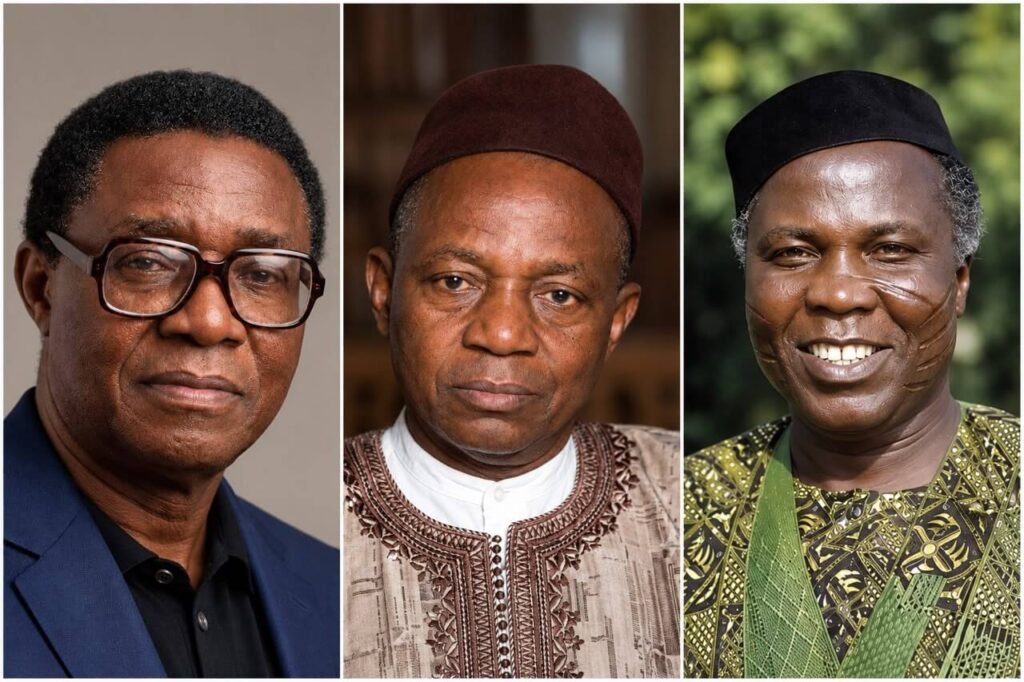
Nigeria’s current stagnation represents a profound missed opportunity: the failure to realize and synthesize the radical, grassroots, and technocratic socio-political visions of Chief Samuel Ladoke Akintola in the Western Region, Mallam Aminu Kano in the North, and Professor Eyo Ita in the Eastern Region.
To understand the transformative potential of what these men envisioned, we must first dissect the architecture of the vertical society that the British colonial state deliberately constructed and left behind. A vertical society is one organized around rigid, top-down hierarchies where power, wealth, and legitimacy flow from an elite core down to a dependent, disenfranchised periphery.
Social mobility is strictly controlled through arbitrary gatekeeping mechanisms, and national cohesion is intentionally prevented by keeping regional populations isolated from one another, connected only at the very top through elite negotiations.
The British colonial project in Nigeria was never designed to build an independent, self-sustaining industrial nation. It was an extraction mechanism. To run this mechanism cheaply, the British relied on two structural pillars: Indirect Rule and a Comprador Bureaucracy—Google it.
In the North, through Lord Frederick Lugard’s system of Indirect Rule, the British co-opted the feudal structures of the Sokoto Caliphate. They transformed the Emirs from traditional spiritual and political custodians into autocratic agents of the colonial state, armed with the power of the Native Authority, colonial police, and arbitrary taxation. This reified a steep vertical pyramid where the Northern aristocracy held absolute power over the Talakawa.
In the South, where centralised feudal monarchies were either less absolute or heavily checked by traditional councils, the British created a different kind of vertical elite: a Western-educated professional and bureaucratic class. This class derived its power not from land or ancient lineages, but from its mastery of the coloniser’s language, law, and administrative procedures. They were the intermediaries—the compradors—who managed the paperwork of extraction.
This structural arrangement required a very specific type of education. The colonial state needed obedient clerks, interpreters, typists, and low-level administrators who could seamlessly integrate into the British civil service and European trading firms. It explicitly did not need engineers, metallurgists, industrial chemists, or mechanized farmers who could invent local solutions and challenge British industrial dominance.
Consequently, the British enacted a series of legal frameworks and educational policies designed to systematically starve the technical and industrial sectors while overfunding and overvaluing a literary, grammar-school education. This historical bottleneck was achieved through several key pieces of legislation:
- The Gold Coast and Lagos Education Ordinance (1882): This first formal government intervention set the precedent by tying state funding (Grants-in-Aid) to a highly rigid, Europeanized academic curriculum. It forced schools to focus almost exclusively on English, reading, writing, and classical arithmetic, reducing manual or technical training to a minor, non-academic distraction.
- The First Nigerian Education Ordinance (1887): Following the political separation of Lagos, this law tied school funding directly to academic examination results. It financially rewarded institutions for producing students who possessed impeccable literary English, formalizing the cultural and economic prestige of the white-collar certificate over practical, industrial capability.
- The Education Code of Southern Nigeria (1903): This code established a centralized Department of Education to standardize a clerk-focused curriculum across the Southern protectorates. It systematically ensured that the few existing industrial training initiatives remained starved of state funding and prestige.
- The Lord Lugard Education Ordinance (1916): Implemented immediately after the 1914 amalgamation, Lugard designed this ordinance to prevent the rise of a politically conscious, technically independent African class. He structured schools into strict hierarchies, ensuring that elite secondary schools trained loyal clerks for the bureaucracy, while completely excluding advanced engineering or technical tracks from higher grant rewards.
- The Imperial Memorandum on Educational Policy in British Tropical Africa (March 1925): Triggered by the American Phelps-Stokes Commissions, this White Paper openly restricted advanced technological education for Africans. Under the paternalistic guise of “adapting education to native life,” it mandated that Africans receive only basic village craft instruction and manual apprenticeships, keeping high-level scientific and technical training strictly out of reach. It ensured that complex industrial tools remained imported and operated by Europeans.
- The Phillipson-Adebo Education Ordinance (1948): Even as it decentralized administration into regional boards after World War II, this policy poured state resources into prestigious grammar schools that prepared students exclusively for white-collar colonial roles and the newly founded University College Ibadan, preserving the elitist, literary hierarchy.
The result of these cumulative policies was the creation of a societal mismatch. By the 1950s, Nigeria had produced a class of nationalists who could speak English better than the British, but who lacked the structural capacity to invent solutions to the country’s technological gaps.
When these elite nationalists inherited the state, they did not dismantle this vertical structure; they occupied it. The mainstream political parties of the First Republic—the Northern People’s Congress (NPC) in the North, the Action Group (AG) in the West, and the National Council of Nigeria and the Cameroons (NCNC) in the East—became instruments for preserving these hierarchies of a totalitarian democracy.
The NPC protected the feudal privileges of the aristocracy, the AG anchored itself in the rising affluent professional and mercantile elite, and the NCNC elite concentrated on consolidating executive grandeur and resource-sharing games at the centre, represented by flamboyant insiders like Dr. Nnamdi Azikiwe—the grammarian general.
The masses—the Talakawa, the Mekunu, and the Eastern rural minority producers—remained at the bottom of the pyramid, their labour extracted and their political agency weaponized through calculated ethnic and regional rivalries. It was within this stifling, vertical context that Samuel Ladoke Akintola, Mallam Aminu Kano, and Professor Eyo Ita launched their disruptive, horizontal rebellions. I’m their disciple. Any other assumption or supposition is delusional.
I go explain… Part 2 Loading
Editor’s Note: This is the first installment of a six-part series by Aoiri Obaigbo

An author, biographer, creative director, and versatile writer. Obaigbo, a former editor of Mister Magazine and former Head of Media and Communication at Shell Nigeria (West), he blends storytelling flair, historical knowledge with editorial skill, and corporate communication expertise in his work. His books include The Wretched Billionaire and The Virgin Widow.
