

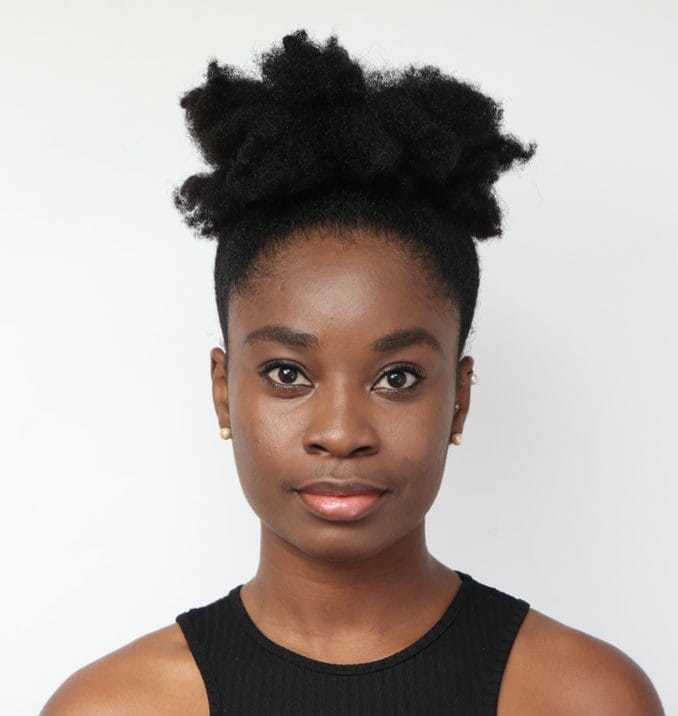
From her early days as Uzoamaka Aniunoh to her emergence as one of Nollywood’s intriguing contemporary performers, Uzoamaka Power is carving out an identity that extends beyond acting, embracing storytelling, filmmaking and artistic reinvention.
There is something particularly fascinating about artists who refuse to be confined by the boundaries of their chosen profession. They are often driven by a curiosity that extends beyond recognition, commercial success or the applause that accompanies a memorable performance.
For them, creativity is not simply about occupying a space; it is about exploring what else is possible within it.
Power appears to belong to this category.
An actress, writer and filmmaker, she has gradually established herself as one of the more interesting creative voices in contemporary Nollywood. Her performances have taken her through romantic drama, psychological horror, historical fantasy and socially conscious storytelling. Yet, perhaps more revealing than the diversity of her acting roles is her growing interest in the creative processes behind the camera.
Formerly known professionally as Uzoamaka Aniunoh, she is increasingly embracing the name Uzoamaka Power. The change offers an interesting entry point into a career that seems to be defined by evolution rather than a willingness to settle into one recognisable identity.
For an industry that often places considerable emphasis on visibility and celebrity, her journey presents a slightly different proposition: an artist interested not only in being seen, but also in shaping what audiences see.
From Fegge to the screen
Aniunoh’s story begins in Fegge, Onitsha, where she grew up as the first of four children. Her father was a trader, while her mother taught Fine Arts.
In an October 2025 interview with THISDAY, she recalled growing up in a four-storey building owned by her father. Her siblings and she were affectionately referred to by neighbours as umu landlord. Their strict upbringing meant that they were rarely allowed downstairs, even to run errands. They found ways to make friends through the balcony railings.
Her childhood recollections offer a glimpse into the environment that shaped her. But it was her early fascination with film and performance that would eventually set her on a different path.
She has identified The Sound of Music as one of the films that first stirred her interest in acting. Watching Julie Andrews play Maria left an impression on her, particularly the character’s freedom, confidence and ability to command a scene.
Nigerian actresses including Genevieve Nnaji, Stephanie Okereke, Dakore Egbuson and Oge Okoye also became important influences.
As a teenager, she would watch their films, memorise their dialogue and recreate scenes in front of a mirror. What might have appeared to others as an ordinary childhood pastime was, in retrospect, an early expression of an ambition she would eventually pursue professionally.
Her decision to pursue acting, however, was not immediately embraced by everyone around her.
She recalled that her father’s understanding of a respectable career was largely centred on conventional office employment. Acting did not initially fit into that picture.
The recognition she received from Nigerian writer Chimamanda Ngozi Adichie, following the publication of an excerpt of her writing, helped change her father’s perception of her creative ambitions.
A writer before an actress
One of the more revealing aspects of her creative journey is that writing preceded acting.
Long before she began appearing on television and in feature films, she was already experimenting with words, documenting personal experiences and developing stories.
She has spoken about sharing her thoughts and everyday experiences on Facebook, an exercise that eventually evolved into a blog in 2014.
Her interest in writing subsequently took a more serious direction when she submitted a story to the Farafina Writing Workshop, facilitated by Chimamanda Ngozi Adichie, and was accepted.
Her literary work has also appeared on platforms including Brittle Paper.
This background offers another way of understanding her approach to acting. An actor interested in the architecture of a story, the motivations of its characters and the language through which they express themselves may approach a performance with a different set of creative considerations.
For Power, writing and acting are not entirely separate pursuits.
Both are avenues through which she explores human behaviour, relationships, emotions and the complexities of everyday life.
Finding her place in Nollywood
She began exploring acting professionally in 2017, following an audition for MTV Shuga.
She secured the role of Cynthia, appearing in the Nigerian production from 2018 and reprising the character in MTV Shuga: Alone Together in 2020.
The series provided an early platform through which audiences could become familiar with her work.
She subsequently appeared in productions including Stuck, Riona, Ìfé, Ponzi, A Naija Christmas and the Showmax thriller series Diiche.
These projects offered different opportunities to explore characterisation, genre and the demands of television and film acting.
Her choices have often reflected an interest in characters whose significance lies in their complexity rather than the amount of screen time they command.
In a 2024 profile published by OkayAfrica, she discussed her attraction to supporting characters, noting the precision required to establish a character’s motivations and emotional world within limited screen time.
It is an interesting perspective in an industry where leading roles are frequently regarded as the most desirable markers of professional advancement.
The performances that brought her into sharper focus
The period around 2023 and 2024 was particularly significant in bringing her work to wider attention.
In C.J. Obasi’s Mami Wata (2023), she played Zinwe, one of the central characters in a visually distinctive film that drew international attention.
Shot in black and white, the production offered an unconventional interpretation of African mythology and storytelling. Its selection for the Sundance Film Festival was an important milestone for Nigerian cinema, placing the work of its cast and creative team before a wider international audience.
If Mami Wata demonstrated her capacity to work within an ambitious cinematic vision, Daniel Oriahi’s The Weekend (2024) offered a different kind of challenge.
She played Nikiya, a woman whose romantic relationship takes her into an increasingly unsettling family environment. The psychological horror film required a performance that could navigate affection, vulnerability, uncertainty and mounting fear.
Power has spoken about initially struggling to understand aspects of Nikiya’s character.
Rather than approach the role through assumptions, she reached back into her own younger experiences of being in love to understand the character’s emotional motivations. It was an approach rooted in empathy rather than judgement: instead of asking whether she would make the same decisions as Nikiya today, she sought to understand the person Nikiya was at that particular moment in her life.
Her performance earned her a Best Actress nomination at the 2024 Africa Movie Academy Awards.
In Korede Azeez’s With Difficulty Comes Ease (2024), she portrayed Zainab, a widowed Muslim woman attempting to rebuild her life while confronting family expectations and social pressures.
The character presented a markedly different emotional landscape from Nikiya. Here, the challenge was to communicate grief, disappointment and resilience through a quieter, more restrained performance.
In Phoenix Fury (2024), she played Ifeatu, a character whose life is shaped by loss, grief and injustice.
Directed by Ifeoma Nkiruka Chukwuogo, the film received significant recognition at the 2024 Africa International Film Festival, where Chukwuogo won Best Director. Power’s performance earned her an Africa Magic Viewers’ Choice Awards nomination for Best Lead Actress.
Her 2024 credits also included Headless, directed by Michael W. Ndiomu, in which she played Inspector Jane, as well as A Quiet Monday, A Night in 2005, Shaping Us, EL&NE and Love Notes.
Taken together, these projects illustrate a particularly productive period in her career, with an expanding range of characters and genres.
Beyond acting: the filmmaker emerges
Perhaps the most compelling aspect of her professional development is her determination to explore filmmaking beyond the demands of performance.
Her transition behind the camera has not been an incidental extension of her acting career; it represents a growing interest in shaping the stories, characters and creative visions that reach audiences.
She made her directorial debut with Love Language (2023), a short film she wrote, directed and starred in.
The project marked an important turning point, allowing her to move from interpreting another filmmaker’s vision to taking responsibility for bringing her own story to the screen.
Its recognition, including a Jury Prize at Nollywood Week Paris and an AMVCA nomination for Best Short Film, offered an encouraging beginning to her journey as a director.
She continued that exploration with My Body, God’s Temple (2025), another short film she wrote and directed, in which she also played Omasilu.
The project further demonstrated her interest in stories that examine relationships, intimacy, personal convictions and the complexities of human experience.
More importantly, it showed a willingness to take on multiple creative responsibilities, exercising control over both the written story and its visual interpretation.
Her subsequent work on Siraam (2025) reinforced that commitment.
Once again, she occupied the writer’s and director’s positions, taking responsibility for translating a story from the page to the screen.
The project represents another step in the development of a filmmaker who appears increasingly comfortable exercising creative authorship rather than limiting her contribution to what happens in front of the camera.
Her screenwriting ambitions have also extended into feature-length storytelling.
With Call of My Life (2026), Power wrote the screenplay and took on the lead role of Soluchi, bringing together her experience as a writer and performer in a commercially released feature film.
The project had an interesting history. She initially began developing the idea in 2018, drawing inspiration from her experience working in a call centre, before returning to it years later with a different understanding of the story she wanted to tell.
She has also received a writing credit on UDO (2026), a short film directed by Timmy Davies.
Taken together, these projects reveal a creative portfolio that extends beyond acting into short-film direction, feature screenwriting and the development of original stories.
The available credits identify her as a writer and director on these projects; they do not establish a producer credit for her, so the distinction is worth preserving.
For Power, the camera is no longer simply a place from which she performs.
It is also a tool through which she can exercise her imagination, interpret stories and shape the experiences audiences encounter.
A new chapter: from the page to the stage
Her creative ambitions are now extending beyond the screen and into live performance.
On November 2, 2026, Power released a teaser for her upcoming one-woman show, Uzoamaka Power is GOING BANANAS, scheduled for February 2027.
A one-woman production places a distinctive responsibility on its central performer, demanding not only the ability to inhabit a character but also the presence, range and storytelling instincts to sustain an audience’s attention.
For an artist whose interests have consistently moved between acting, writing and directing, the stage offers another space in which to explore her creative identity.
Details of the production’s storyline and staging have yet to be established publicly.
But the announcement itself adds a new dimension to a career already marked by movement across creative disciplines.
From film sets to the director’s chair, and now towards a solo theatrical production, she continues to explore the possibilities of her craft.
The art of becoming
There is a particular significance to the name Uzoamaka Power.
For years, audiences encountered her as Uzoamaka Aniunoh. Today, she is increasingly identified professionally as Uzoamaka Power.
The name, which she associates with strength, resilience and creative energy, coincides with a period in which her artistic identity has expanded considerably.
She is not simply the actress audiences remember from MTV Shuga or the performer who delivered compelling turns in The Weekend and With Difficulty Comes Ease.
She is also a writer developing original stories, a director exploring her own visual language and a creative professional increasingly interested in having a say in the narratives that reach the screen.
Her journey raises an interesting question about the expectations placed on contemporary African actresses.
Must an actress remain within the boundaries of performance, or can she become an architect of the stories she once depended on others to create?
Her trajectory suggests that the latter possibility is worth pursuing.
There is, of course, still considerable room for her career to develop.
Her screenwriting ambitions will require sustained investment, her directorial work will need to find increasingly wider audiences, and the challenge of maintaining creative independence while navigating the commercial realities of filmmaking remains significant.
But perhaps that is precisely what makes her journey interesting.
She does not appear to be pursuing a single destination.
Instead, she is exploring the possibilities that emerge when an artist refuses to be defined by one discipline.
From Cynthia in MTV Shuga to Nikiya in The Weekend, Ifeatu in Phoenix Fury and Soluchi in Call of My Life, each character has presented a different opportunity to explore the human experience.
Behind those performances is a writer who wants to tell stories, a director who wants to bring her imagination to life and an actress who continues to challenge herself with each new undertaking.
Perhaps the most interesting thing about Uzoamaka Power is not simply what she has achieved, but what she is still becoming.
Some artists spend their careers trying to establish an identity.
Others spend theirs discovering how many different identities their creativity can accommodate.
She appears to be doing both.
