

The US/Israel vs Iran war and the latter’s closure of the straight of Homuz unleashed a fossil fuel shock that has hit economies far from the Middle East and the US. With the price of crude oil hit record highs and it is attendance effect on petrol and diesel, motorists are considering their options.
The price of petrol has risen from the pre-February 28 price of about N800/l to N1250lt in most parts of Nigeria, Africa’s most populace nation. Fuel costs influence the choice of cars in Nigeria, with Nigeria drivers choosing between a 4-plug (16-cylinder) and 6-plu (24-cylinder) engines.
Hybrid vs EV Explained:
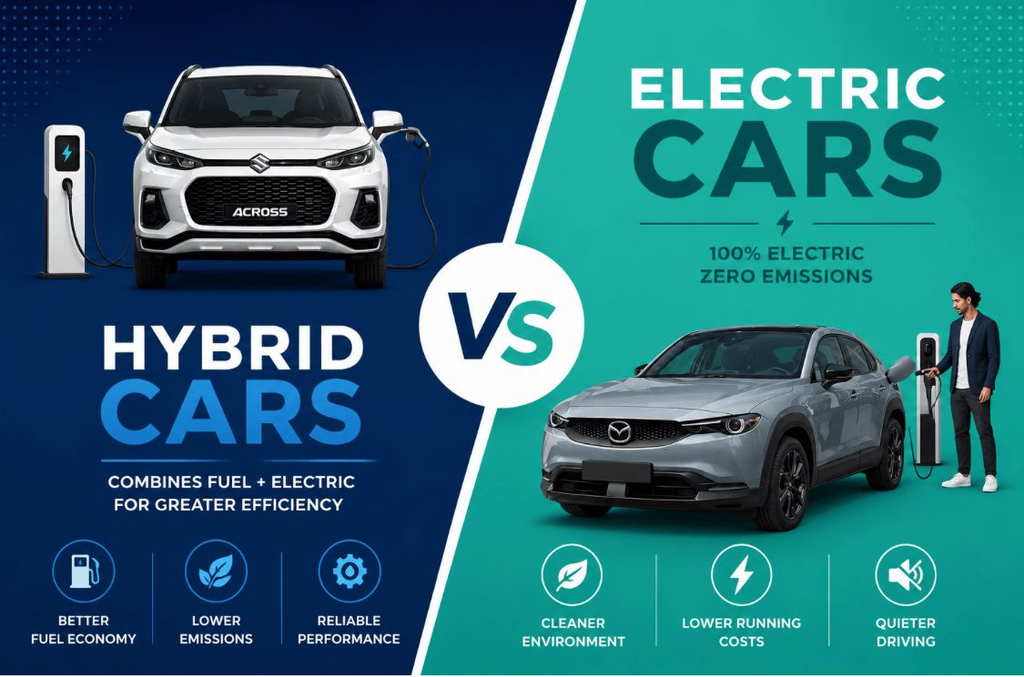
Recently, more motorists are considering hybrid vehicles and electric vehicles (EVs). While both set of cars use electric power, but they are fundamentally different. The most important question raise is which car is better for Nigerian motorists.
A hybrid combines a petrol engine with an electric motor and battery. The electric motor assists the engine, particularly during acceleration and low-speed driving, helping to reduce fuel consumption. The battery is recharged mainly through the engine and regenerative braking, which converts some of the energy normally lost when a car slows down into electricity.
For most conventional hybrids, there is no need to plug the car into a charger. This makes them attractive in Nigeria, where public charging infrastructure is still developing.
An EV, on the other hand, runs entirely on electricity. It has a large battery pack and electric motor but no petrol engine, fuel tank or exhaust system. The battery must be recharged using a home or public charger.
EVs also use regenerative braking and generally have fewer moving parts than petrol-powered cars. That means there is no engine oil, spark plugs or conventional exhaust system to maintain, potentially reducing routine servicing costs.
For Nigerian motorists, however, charging remains a major consideration. An EV can be economical to operate, but its practicality depends on reliable access to electricity, a suitable home charging setup or nearby charging stations. Solar and inverter systems can also provide alternatives for some owners.
Plug-in hybrids offer a middle ground. Their larger batteries can be charged externally and allow some electric-only driving, while the petrol engine provides backup for longer journeys.
The choice, therefore, is not simply about which technology is newer.
Hybrid vs EV:
Hybrid: petrol + electricity.
EV: electricity only.
For motorists who want better fuel economy without depending entirely on the power grid, a hybrid may currently offer greater flexibility. For those with dependable charging access and a willingness to go fully electric, an EV could provide lower running and maintenance costs.
