

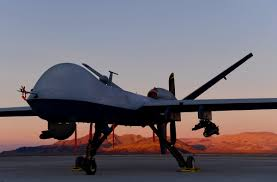
The United States has deployed MQ-9 Reaper surveillance drones and about 200 military personnel to northern Nigeria to support local forces battling Islamist insurgent groups, including Islamic State West Africa Province (ISWAP) and Boko Haram, officials said.
U.S. officials quoted by German broadcaster Deutsche Welle said there would be no US troops involvement in the fight, stressing that US personnel would provide training and technical assistance.
The deployment would focus on intelligence gathering, training and technical assistance rather than direct combat operations.
The support is expected to prioritise conflict-hit states in the northeast, particularly Borno, as well as other parts of northern Nigeria where militant attacks and banditry have intensified in recent months.
The move comes against the backdrop of worsening insecurity across the wider Sahel region, where jihadist violence linked to Islamic State and al-Qaeda affiliates has spread across Mali, Niger and Burkina Faso.
Analysts say porous borders, weak state control and economic hardship have enabled armed groups to expand recruitment and cross-border operations, raising fears of further regional destabilisation.
In Nigeria, a more than decade-long insurgency has overlapped with mass kidnappings, rural banditry and communal violence, complicating security operations and deepening humanitarian challenges. Thousands have been killed and millions displaced, while attacks on transport routes, farming communities and security installations continue to undermine economic recovery efforts in the north.
The MQ-9 Reaper, developed by U.S. defence contractor General Atomics, is a long-endurance remotely piloted aircraft widely used for intelligence, surveillance and reconnaissance missions.
Defence estimates suggest a single MQ-9 unit can cost roughly $30 million to $32 million, excluding operational and maintenance expenses, with a full system package running significantly higher depending on sensors and weapons configurations.
Capable of remaining airborne for more than 24 hours and operating at high altitudes, the drone can transmit real-time imagery and targeting data to ground command centres, enabling forces to track insurgent movements across vast and difficult terrain.
Military analysts say its effectiveness lies in persistent surveillance, rapid strike capability in armed configurations and reduced risk to pilots, making it a key tool in counter-insurgency operations in remote regions such as the Sahel.
Security experts caution, however, that while enhanced intelligence support could improve tactical outcomes against insurgent networks, lasting stability in northern Nigeria and the wider Sahel will depend on addressing governance deficits, youth unemployment, poverty and weak border management systems that continue to fuel cycles of violence.
