

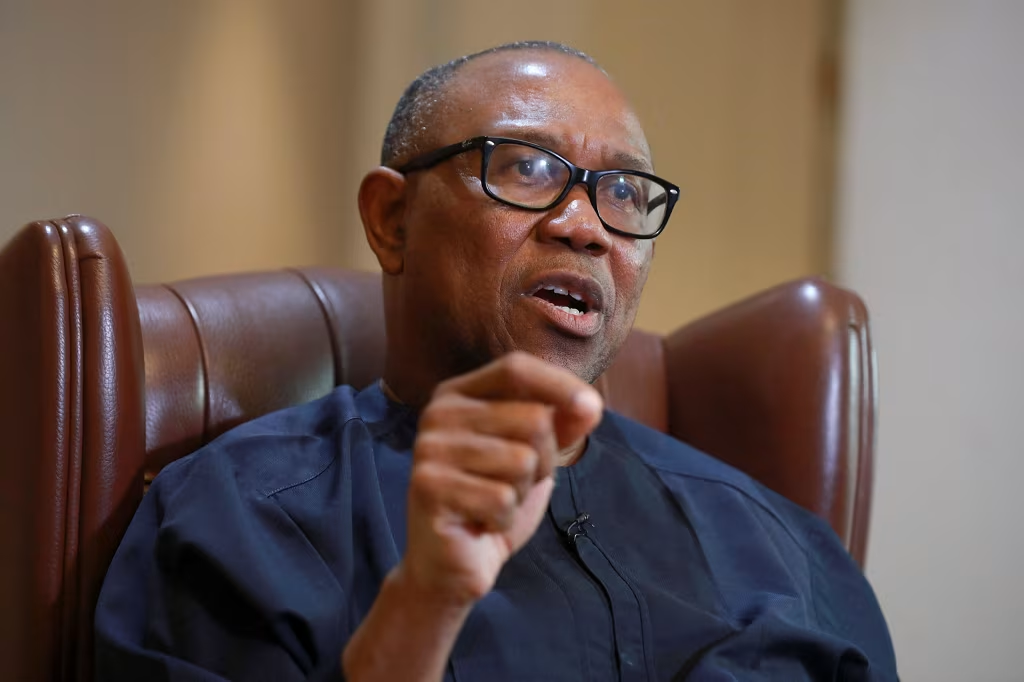
The presidential candidate of the Nigeria Democratic Congress (NDC), Peter Obi, has come under criticism from the Presidency, Minister of the Federal Capital Territory (FCT), Nyesom Wike, and other Nigerians following his participation in the singing of Nigeria’s former national anthem at a political event in Lagos.
Obi and some of his supporters reportedly sang the old anthem, Arise, O Compatriots, during an NDC town hall meeting in Lagos on Thursday, despite the Federal Government’s reinstatement of Nigeria, We Hail Thee as the country’s national anthem in May 2024.
The development has triggered reactions from prominent Nigerians, who accused the former Anambra State governor and his supporters of disregarding an existing law and showing disrespect for the country’s national symbols.
Among those who condemned the action was Temitope Ajayi, Senior Special Assistant to President Bola Tinubu on Media and Publicity, who questioned Obi’s suitability for the presidency.
In a post on his Facebook page, Ajayi argued that anyone aspiring to lead the country should demonstrate respect for its laws and national institutions.
He said Obi should have insisted that the gathering observe the officially recognised national anthem rather than join his supporters in singing the former one.
According to Ajayi, leadership requires the courage to stand for what is right, even when doing so may be unpopular with supporters.
He cited an incident involving former United States Senator John McCain during the 2008 presidential campaign, when McCain challenged a supporter who made allegations about his opponent, Barack Obama, regarding his citizenship and religion.
Ajayi said McCain demonstrated maturity and leadership by refusing to allow the supporter to use his campaign platform to promote divisive claims.
He added that Obi should similarly have prevented what he described as an assault on Nigeria’s sovereignty and national identity.
Also weighing in on the controversy, a Facebook user identified as Law Parlour argued that the national anthem was not a matter of personal preference.
The user recalled that Tinubu signed the National Anthem Act 2024 into law on May 29, 2024, restoring Nigeria, We Hail Thee as the country’s national anthem.
He cited Sections 1, 2 and 5 of the Act, which respectively recognise the anthem, establish it as a national symbol that must be respected and require people present to conduct themselves respectfully when it is performed or sung.
While acknowledging that Nigerians were entitled to disagree with the decision to restore the old independence anthem, he maintained that such disagreements did not override the existing law.
He added that the National Assembly remained the constitutionally recognised body with the authority to amend the legislation.
Wike also joined the criticism on Friday, accusing Obi of lawlessness and attempting to undermine national unity through his alleged conduct at the Lagos event.
The FCT minister spoke at a stakeholders’ town hall meeting in Ogu-Bolo Local Government Area of Rivers State, organised by the Rainbow Coalition to mobilise support for Tinubu’s re-election bid in 2027 and other All Progressives Congress candidates.
Addressing traditional rulers, community leaders, youths and political supporters, Wike questioned why someone seeking to become Nigeria’s president would allegedly refuse to recognise the country’s officially approved national anthem.
He said Obi’s reported decision to remain seated during the performance of the national anthem, while standing when the former anthem was sung, raised concerns about his commitment to Nigeria.
Wike said, “A whole national anthem of a country is being sung. A man who wants to be President of Nigeria would disobey and sit down. And then, not only that, when a different national anthem that is not being used for Nigeria was sung, he stood up.
“In a way, he does not belong to this country. In a way, he has said he does not belong to this country; that if you give him the presidency, he would do a different thing that will divide Nigeria.”
The minister further argued that anyone who disrespected the country’s national symbols should not be entrusted with the nation’s highest political office.
Wike also questioned Obi’s political record, accusing him of abandoning political parties whenever disagreements arose rather than remaining to resolve internal disputes.
He equally faulted the former Anambra governor for allegedly failing to conduct local government elections throughout his eight-year tenure, describing the record as inconsistent with his professed commitment to the rule of law.
The minister extended his criticism to the opposition alliance involving former Vice-President Atiku Abubakar and former Rivers State Governor Rotimi Amaechi.
He questioned their records in public office, particularly Amaechi’s performance as Minister of Transportation, and accused him of failing to fulfil some development promises in Rivers State.
Wike specifically alleged that Amaechi demolished Government Secondary School, Ogu, without rebuilding it and failed to deliver a proposed 1,000-bed specialist hospital.
The minister urged residents of Ogu-Bolo to disregard what he described as the opposition’s political rhetoric, insisting that the Tinubu administration had facilitated development projects and appointments for the area.
He cited the construction of the Ogu-Bolo Civic Centre and federal appointments secured for indigenes as examples of the administration’s contributions.
Wike subsequently urged the people to support Tinubu’s 2027 re-election bid, as well as Kingsley Chinda’s governorship ambition and other APC candidates contesting National Assembly seats.
Earlier, the Ogu-Bolo Local Government Chairman, Vincent Nemieboka, assured the minister of the area’s support, attributing the council’s position to projects and political appointments facilitated for its people.
The Amanyanabo of Bolo, King Acheseinimie Frank, also commended Wike, highlighting infrastructure projects executed through the Niger Delta Development Commission, including road construction, sand-filling projects and work on the Kira-Ogu-Bolo Road.
Similarly, the Chairman of the Ogu Divisional Council of Chiefs, Chief Lawrence Abeabiari, reaffirmed the traditional institution’s support for the Rainbow Coalition and its political candidates.
He disclosed that two infrastructure projects in the area had been named after Wike in recognition of his contributions.
They include Wike Road at Enelechi Phase One and the Wike Sandfield.
Also speaking, a community stakeholder, Prof. Lucky Worika, listed several projects and federal appointments he attributed to Wike’s influence and interventions in the area.
Among the projects he mentioned were the reconstruction of Ogu General Hospital, installation of a 70kVA solar power station, construction of the Ele/Opu-ama Link Road and Kira-Bolo Road, internal roads, streetlights, housing projects and teachers’ quarters.
He also listed scholarships, free medical outreaches and youth skills acquisition programmes among the interventions.
Worika further recalled projects executed during Wike’s tenure as Rivers State governor, including the reconstruction of Government Secondary School, Ogu, the Kira Bridge, Ogu-Eteo and Ogu-Wakama link roads, and a landing jetty in Ele community.
He, however, urged the minister to use his position at the federal level to attract further development to Ogu-Bolo, particularly in healthcare, potable water, electricity and maritime transportation.
He also highlighted environmental challenges and the need to improve infrastructure in the riverine communities.
