

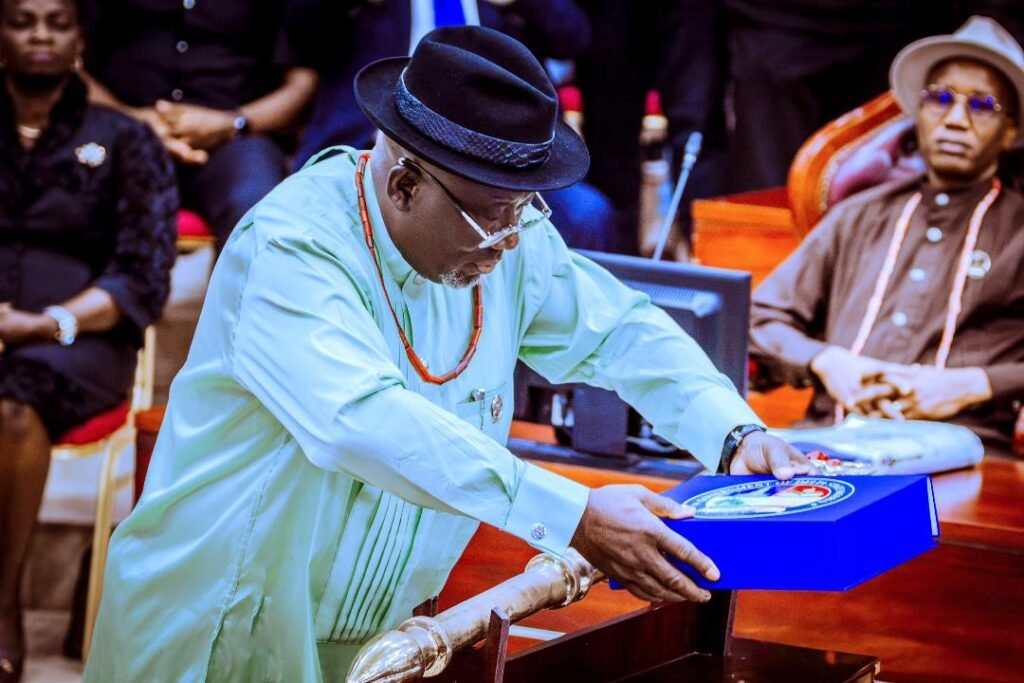
Delta State Governor Sheriff Oborevwori on Monday presented a proposed N1.23 trillion Delta 2027 budget to the state House of Assembly, with N806.8 billion, or about 65%, earmarked for capital projects.
The proposed Delta State 2027 budget, tagged the “Budget of Sustained Prosperity and Enhanced Growth,” provides N430 billion for recurrent expenditure and is N493.01 billion, or 28.5%, lower than the N1.729 trillion budget approved for 2026.
Oborevwori said the lower spending plan reflected a deliberate move towards more realistic projections and stronger fiscal discipline, while prioritising infrastructure, economic diversification, human capital development and social interventions.
Delta 2027 budget: N320bn for roads
The two Ministries of Works are to receive N320 billion for road infrastructure and the completion of ongoing projects, making it the largest sectoral allocation in the proposed budget.
Oborevwori said his administration had embarked on 872 road projects and 20 bridges and flyovers since assuming office, covering 2,348 kilometres of roads and 1,871 kilometres of drainage infrastructure.
He said consultations with communities showed that roads, bridges and jetties remained among the most pressing needs, particularly in rural and riverine communities.
The governor said the government would focus on completing ongoing projects while starting new investments considered critical to economic development.
N74bn allocated to education, N50bn to health
Education received a proposed N74 billion allocation, comprising N10 billion for primary education, N12 billion for technical education, N12 billion for secondary education and N40 billion for higher education.
Oborevwori said the government would continue investments in school rehabilitation, teacher development, digital learning, laboratories and accreditation of academic programmes.
He also disclosed that N10.8 billion had been approved for the rehabilitation and renovation of primary and secondary schools.
The health sector was allocated N50 billion for hospital upgrades, medical supplies, recruitment and welfare of healthcare personnel.
Oborevwori also highlighted the College of Health Technology, Ovrode, which he said had enrolled more than 800 pioneer students, as part of efforts to address shortages of health workers.
Delta IGR rises to N283bn
The governor said Delta’s internally generated revenue had grown from N83 billion in 2023 to a projected N283 billion by December 2026.
He attributed the increase to technology-driven revenue collection, an expanded revenue base and measures to reduce leakages without imposing additional tax burdens on residents.
Oborevwori also disclosed that N400 billion of the state’s N463 billion legacy debt had been repaid, leaving N63 billion outstanding.
He expressed confidence that the remaining debt would be cleared by the end of the first quarter of 2027.
Delta economy and investment
On economic diversification, Oborevwori said the state was attracting private investment into agriculture, industrialisation, entertainment and small and medium-sized enterprises.
He cited the $70 million Olam Agri feed mill project at Ogwashi-Uku as one of the investments linked to the 2026 Delta State Economic and Investment Summit.
The governor said the project would create jobs and provide a market for locally produced agricultural commodities.
He further said Delta’s gross domestic product rose from N14.5 trillion in 2024 to approximately N17.9 trillion in 2025, making the state Nigeria’s fifth-largest state economy.
Energy and social interventions
The proposed budget includes N12 billion for energy, N10 billion for urban and physical planning, N5 billion for agriculture and N5 billion for social interventions.
Another N50 billion is earmarked for the state’s 25 local government areas, while N20 billion each is proposed for the Delta State Capital Territory Development Agency and the Warri-Uvwie and Environs Development Agency.
Oborevwori said the administration had also executed 2,155 energy projects, including 90 transformers, 2,003 solar street-lighting projects and 23 power-grid extensions.
13th-month salary, security
The governor said he had assented to the 13th-month salary law for public servants, with implementation beginning in December 2026.
He said the measure was intended to recognise workers’ contributions and provide additional financial support during the festive period.
On security, Oborevwori said the state was strengthening cooperation with security agencies to tackle kidnapping, cultism, pipeline vandalism and other criminal activities.
He disclosed that approval had been given for the construction of 25 police divisional headquarters for state police, while the state had applied to recruit 1,000 forest guards.
Delta Assembly begins budget consideration
Oborevwori subsequently presented the Appropriation Bill to the Assembly for consideration and approval.
House Speaker Emomotimi Guwor commended the governor’s performance in infrastructure, healthcare, education, social welfare and human capital development.
Guwor said the Assembly would give the proposed budget thorough and timely consideration and would take its second reading on Tuesday, Nov. 17.
The proposed Delta 2027 budget will now undergo legislative scrutiny before possible passage into law.
