

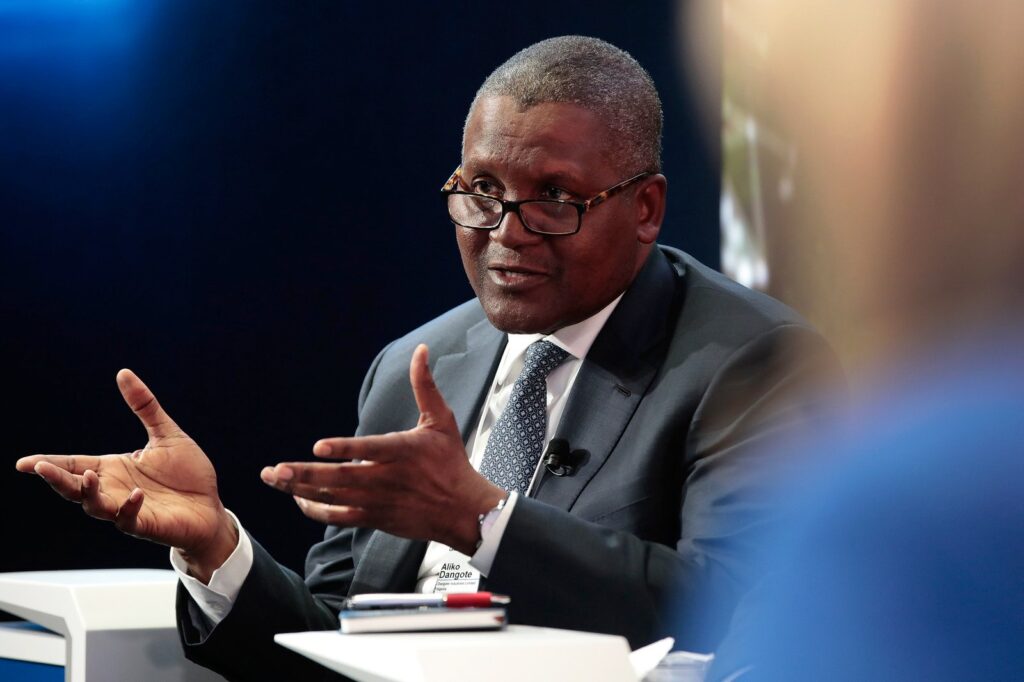
Africa’s richest man, Aliko Dangote, has announced plans to build a 650,000 barrels-per-day refinery in East Africa, mirroring the scale of his flagship facility in Nigeria, as part of a broader push to strengthen industrial capacity across the continent.
Dangote announced on Thursday at a high-level summit in Nairobi attended by African leaders, financiers, and industry stakeholders focused on addressing the continent’s energy and infrastructure challenges.
Speaking at the event, Dangote told William Ruto and Yoweri Museveni that the proposed refinery would depend heavily on strong government backing and consistent policy support.
He disclosed that the project forms part of a wider investment drive, revealing that his group plans to commit $40 billion to various sectors across Africa by 2030. Dangote expressed confidence in the refinery’s viability, stating that nothing would stand in the way of its success if adequate support is provided.
The industrialist used the platform to emphasise the need for Africa to reduce its dependence on imports and build local production capacity. According to him, exporting raw materials while importing finished goods undermines job creation and economic growth on the continent.
He stressed that industrialisation—particularly in refining, fertiliser production, and petrochemicals—is essential for reversing this trend and creating sustainable employment opportunities.
The proposed refinery comes against the backdrop of projections by the Africa Finance Corporation, which warned that Africa could face an 86 million tonne fuel shortfall by 2040. The report noted that the continent currently imports over 70 percent of its refined fuel and spends about $230 billion annually on key imports.
Echoing Dangote’s position, President Ruto urged a shift in Africa’s economic strategy, cautioning that continued reliance on external capital focused on raw material extraction would limit the continent’s development potential.
Beyond refining, Dangote highlighted ongoing efforts to expand fertiliser production and petrochemical capacity across Africa, including plans to boost urea output and establish blending plants in underserved regions.
He reiterated his belief in Africa’s potential for self-sufficiency, describing the refinery proposal as part of a broader vision to transform the continent into a global industrial powerhouse.
As discussions progress, the planned East African refinery is expected to play a critical role in addressing fuel supply gaps while advancing Africa’s long-term goal of economic independence.
