

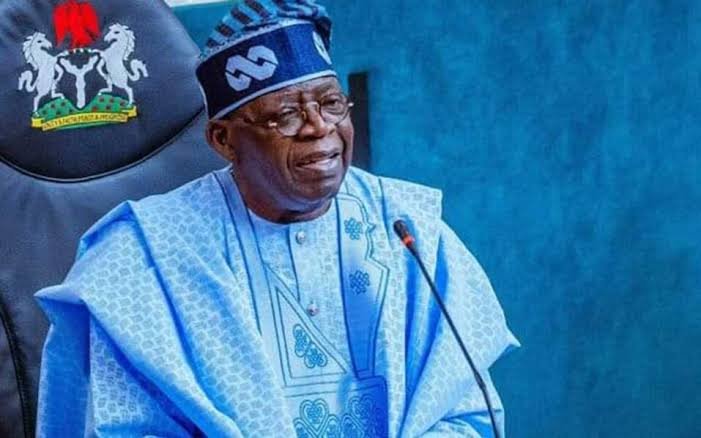
Photo: President, Federal Republic of Tinubu
By Austin Manekator
President Bola Ahmed Tinubu assumed the reins of Nigeria’s leadership on May 29, 2023. Within two years of taking office, a cloying trend has emerged — an unending number of public facilities, roads, airports, and institutions across Nigeria have been renamed in his honour. From Abuja to Minna, and from barracks to libraries, there seems to be no infrastructure or facility that hasn’t been engraved with his name — except the country Nigeria itself.
The Bola Tinubu Rechristening Charade: 10 Major Landmarks That Now Bear His Name:
- Bola Ahmed Tinubu International Airport, Minna, Niger State – March 2024
- Bola Ahmed Tinubu Way, Abuja (formerly Southern Parkway) – May 2024
- Bola Tinubu Library (National Assembly Library), Abuja – May 2024
- Bola Ahmed Tinubu Technology Innovation Complex (BATTIC), Abuja – December 2024
- Bola Ahmed Tinubu Barracks, Asokoro, Abuja – January 2025
- Bola Ahmed Tinubu Polytechnic, Gwarinpa, Abuja – January 2025
- Bola Ahmed Tinubu International Conference Centre, Abuja – June 2025
- Bola Tinubu Exchange Road, Lafia, Nasarawa State – June 2025
- Bola Ahmed Tinubu Road, near the Dangote Refinery in Lagos – June 2025
- Proposed Bola Ahmed Tinubu Federal University of Nigerian Languages, Aba – Bill introduced in October 2024.
That’s ten institutions in just two years. At this rate, one could be forgiven for wondering whether “Nigeria” itself might soon be renamed Tinubuland.
SHAMELESS DISPLAY OF ‘LOYALTY’
In a country where public praise is often seen as a currency of loyalty, naming infrastructure after sitting presidents isn’t new. We’ve seen it before with former presidents — Olusegun Obasanjo, Goodluck Ebele Jonathan, and Muhammadu Buhari — but never at Bola Ahmed Tinubu’s scale and speed.
A few of these have come from the federal level — like the library and innovation complex — while many have been initiated by state governors and ministers eager to curry favour or demonstrate allegiance. FCT Minister Nyesom Wike, for example, has become a prominent figure in this trend, renaming multiple facilities within Abuja after Tinubu in 2024 and 2025.
Governors — Niger State’s Umar Bago and Nasarawa’s Abdullahi Sule — have also caught the fever. They used presidential visits as opportunities to unveil newly christened roads and flyovers. These gestures often come with ceremonies, photo ops, and glowing speeches about “leadership” and “vision.” But for ordinary Nigerians watching from the sidelines, the optics can feel less like honour and more like overkill.
For the common man, the frenzy of renaming is not only unnecessary but also deeply absurd — especially in the face of their everyday realities: electricity is unreliable; inflation has triggered a cost-of-living crisis; hospitals have become mere consulting centres; insecurity is widespread. Amidst these pressing national issues, public officeholders appear more focused on immortalizing a man who is at the centre of these problems — at considerable public expense.
In Abuja, the Federal Capital Territory, the city has gained a Bola Tinubu Way, a Bola Tinubu Library, a Bola Tinubu Conference Centre, a Bola Tinubu Polytechnic, and even a Bola Tinubu Barracks — all within the last 12 months. One would think the president had personally constructed the city from scratch.
Even the renaming of roads has sparked anger. Many residents have pointed out that the Southern Parkway — now Bola Ahmed Tinubu Way — was a symbolic and functional landmark, and its abrupt renaming erased years of historical and spatial identity.
Beyond the theatrics lies a deeper concern: the culture of hero-worship and political sycophancy. In a healthy democracy, leaders are remembered by the legacies they leave, not by how many buildings bear their names. But in Nigeria, it’s often the reverse. The name becomes the legacy — whether or not the leader has earned it.
This naming spree reflects an environment where political loyalty trumps public service, where praise is weaponised for access and protection, where the line between governance and flattery is dangerously blurred.
It also raises questions about accountability. If a road is named after the president today and collapses tomorrow, who takes responsibility? If an airport bearing his name experiences a security failure, will that name remain — or quietly be reversed? The naming of public infrastructure should ideally reflect enduring legacies — not fleeting political alignments.
While President Tinubu has not publicly demanded these gestures, his acquiescent silence in the face of these embarrassing cases has encouraged and allowed the trend to flourish. In an ideal scenario, a sitting president would reject excessive personal canonisation and instead champion merit-based naming, community consultation, and national consensus. He and his minders are lost in the endless vain glorification, not realising that canonisation and adoration are only worthy when they are done after he bows out of office.
Meanwhile, Nigeria is not short of heroes. There are countless innovators, educators, community leaders, civil rights advocates, and artists who have shaped this country far more profoundly than any sitting president. Yet, there is rarely infrastructure named after them. Instead, we have become a nation of nameplates, where political favour outweighs societal impact.
This is not just a harmless quirk — it’s a sign of how we perceive leadership, loyalty, and legacy. If public officials spent half as much time delivering on promises as they do naming things after their bosses, perhaps Nigerians would have less reason to be cynical. While some might argue that naming roads and buildings is symbolic, symbols matter. And when those symbols are overused, they lose meaning.
