

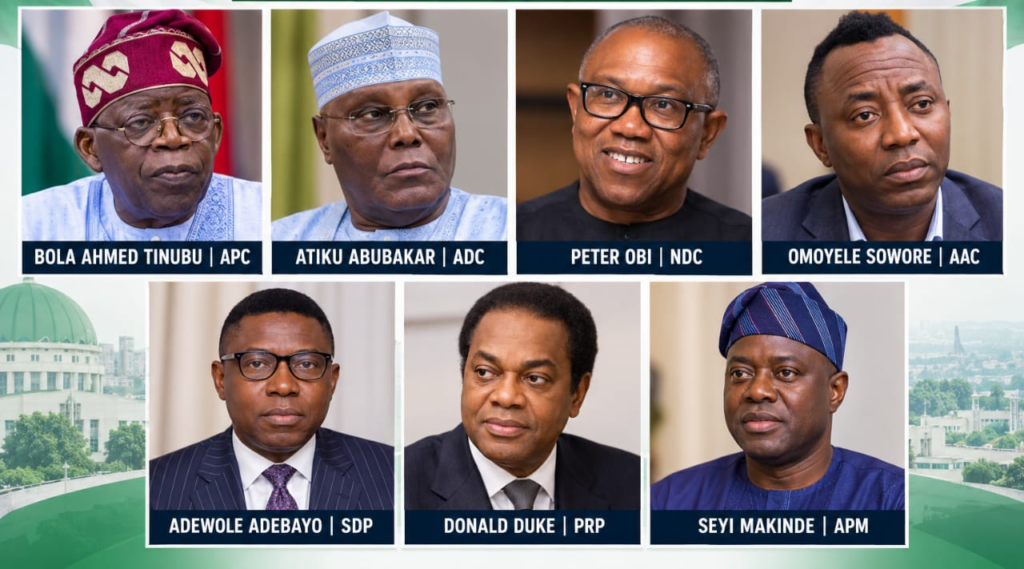
The Nigeria 2027 presidential election is beginning to take shape as political parties intensify campaigns, mobilisation and voter engagement ahead of the January 16, 2027 poll.
The Independent National Electoral Commission (INEC) has published its final list of presidential candidates and their running mates. The list released in September contains 18 presidential candidates from different political parties.
The development followed the completion of party primaries and the submission of candidates’ particulars under the Electoral Act 2026.
The presidential and National Assembly elections are scheduled for Saturday, January 16, 2027, while governorship and State House of Assembly elections are scheduled for February 6.
Campaigns officially began on August 19, 2026, putting the presidential contenders in a more visible contest for the votes of Nigerians.
President Bola Ahmed Tinubu of the All Progressives Congress (APC) formally launched his re-election campaign in Kaduna on October 24, while opposition candidates are also stepping up their engagements across the country.
The 2027 contest features a mixture of familiar political figures, former governors, a former vice-president, activists, lawyers, businessmen and less-known candidates seeking to break into Nigeria’s increasingly competitive presidential politics.
Here is a look at the candidates, their political backgrounds and what voters should know about them.
1. Bola Ahmed Tinubu — APC
Running mate: Kashim Shettima
Age: 74
The incumbent president, Bola Ahmed Tinubu, is seeking a second term under the platform of the All Progressives Congress.
Tinubu was governor of Lagos State from 1999 to 2007 and later became one of the leading figures in the formation and consolidation of the APC.
Before entering politics, he worked in the corporate sector and served as a senior executive at Mobil Oil Nigeria. His political career has been closely associated with Lagos and the development of a powerful political network that has influenced national politics for more than two decades.
He won the 2023 presidential election and assumed office as Nigeria’s president on May 29, 2023.
His administration has focused heavily on economic reforms, including the removal of the petrol subsidy, changes to the foreign-exchange system and tax reforms.
The reforms have been defended by the government as necessary measures to strengthen public finances and attract investment. However, they have also been accompanied by significant increases in the cost of living, making the economy one of the major issues of the 2027 campaign.
Tinubu’s campaign is therefore likely to centre on the argument that his reforms require time to deliver their full benefits, while his opponents are expected to focus on inflation, insecurity and economic hardship.
2. Atiku Abubakar — ADC
Running mate: Rotimi Amaechi
Age: 79
Atiku Abubakar is one of the most experienced presidential contenders in the 2027 race.
The former vice-president served alongside President Olusegun Obasanjo from 1999 to 2007. He has also contested the presidency several times, making him one of the most recognisable figures in Nigeria’s opposition politics.
Atiku has built his political platform around issues including economic reform, restructuring, devolution of powers and a stronger role for the private sector.
For the 2027 election, he is contesting under the African Democratic Congress (ADC), with former Rivers State governor and former Minister of Transportation Rotimi Amaechi as his running mate.
The ticket brings together two experienced politicians with substantial political networks.
Atiku’s long political career remains one of his major strengths, although his repeated presidential contests and age are also likely to feature prominently in the campaign debate.
3. Peter Obi — NDC
Running mate: Rabiu Musa Kwankwaso
Age: 65
Peter Gregory Obi enters the 2027 race as one of the most closely watched opposition candidates.
The former Anambra State governor was the Labour Party’s presidential candidate in the 2023 election, where he finished third but recorded strong support, particularly among younger voters and in several parts of southern Nigeria.
Obi previously served as governor of Anambra State from 2006 to 2014 and had earlier built a career in business.
His political messaging has consistently emphasised prudent management of public resources, production, education, healthcare and reducing government waste.
His 2027 ticket has attracted considerable attention because his running mate is Rabiu Musa Kwankwaso, the former Kano State governor and 2023 presidential candidate of the New Nigeria Peoples Party.
The Obi-Kwankwaso ticket brings together two politicians with significant support bases in different regions of the country.
The major question surrounding the ticket will be whether it can convert the support generated by both politicians into a sufficiently broad national coalition capable of defeating the incumbent.
4. Seyi Makinde — APM
Running mate: Musa Lawal Daura
Age: 58
Oyo State Governor Oluseyi Abiodun Makinde is making his first presidential run after two terms as governor.
Makinde, an engineer and businessman, built his career in the oil and gas industry before entering politics. He founded Makon Engineering and Technical Services and developed interests in energy infrastructure and related sectors.
He was elected governor of Oyo State in 2019 and re-elected in 2023.
His political profile has been built largely around governance, infrastructure, economic development and public-sector management.
He is contesting on the platform of the Allied Peoples’ Movement (APM).
Makinde’s campaign is expected to draw heavily on his record in Oyo State and his argument that experience at the state level can be transferred to the federal government.
5. Sandy Ojang Onor — PDP
Running mate: Umaru Babangida
Age: 60
Sandy Ojang Onor is the presidential candidate of the Peoples Democratic Party (PDP).
A former senator and academic, Onor represents the PDP in a presidential contest in which the party is attempting to retain its relevance after losing the presidency in 2015 and again in 2023.
His candidacy comes at a critical period for the PDP, which has faced internal disagreements and defections ahead of the 2027 election.
Onor’s campaign will therefore be watched not only for its presidential message but also for the ability of the PDP to rebuild its national structure and reconnect with voters.
6. Omoyele Sowore — AAC
Running mate: Haruna Garba Magashi
Age: 55
Omoyele Sowore is a journalist, activist, writer and political campaigner.
He is the founder of Sahara Reporters and has spent years advocating political accountability, anti-corruption measures and fundamental political reforms.
Sowore has previously contested the Nigerian presidency and has remained one of the most outspoken critics of successive administrations.
His African Action Congress (AAC) campaign is expected to focus strongly on political restructuring, accountability, corruption and what he describes as the need for fundamental changes to Nigeria’s political system.
7. Donald Duke — PRP
Running mate: Kabiru Rabiu
Age: 64
Donald Duke is a former governor of Cross River State and one of the more recognisable names among the candidates outside the three major political contenders.
He served as governor of Cross River State for two terms and was particularly associated with tourism, infrastructure and urban development.
Duke is a lawyer by training and has also worked in the private sector.
His experience as a former governor gives him direct executive experience, while his political challenge will be translating that profile into a nationwide presidential campaign.
He is contesting under the Peoples Redemption Party (PRP).
8. Adewole Ebenezer Adebayo — SDP
Running mate: Usman Muhammed Bugaje
Age: 54
Adewole Adebayo is a lawyer and businessman who previously contested the presidency in the 2023 election under the Social Democratic Party (SDP).
He has emphasised governance, institutional reform, accountability and economic development.
His return to the presidential race gives the SDP another opportunity to present itself as an alternative to the country’s larger political parties.
9. Sunday Chibuzo Okereke — LP
Running mate: Hajja Bintu Konto
Age: 43
Sunday Chibuzo Okereke is the presidential candidate of the Labour Party.
At 43, he is among the younger candidates in the race.
INEC’s published particulars list him as holding multiple academic qualifications, including a PhD, master’s degrees and a bachelor’s degree.
His candidacy comes after Peter Obi’s departure from the Labour Party following his 2023 presidential run.
The Labour Party will therefore face the challenge of maintaining the political visibility and support it gained during the 2023 election.
10. Rufai Adekunle Omo-Aje — AA
Running mate: Shehu Hussaini
Age: 71
Rufai Adekunle Omo-Aje is the presidential candidate of the Action Alliance.
At 71, he is one of the older candidates in the race.
His candidacy represents one of the smaller political platforms seeking to offer Nigerian voters an alternative to the larger parties.
11. Abbas-Bin Aliyu — ADP
Running mate: Ike Chinazam
Age: 44
Abbas-Bin Aliyu is the presidential candidate of the Action Democratic Party.
At 44, he is among the younger presidential contenders on the INEC list.
His candidacy adds another alternative to the field as smaller parties seek to use the 2027 election to expand their political presence.
12. Yusuf Kabiru — APP
Running mate: Peace Egobia Ofordile
Yusuf Kabiru is the presidential candidate of the Action Peoples Party.
His running mate, Peace Egobia Ofordile, is one of the women selected as a vice-presidential candidate in the 2027 race.
The ticket is among those seeking to attract voters looking beyond the country’s dominant political parties.
13. Sunday Adenuga — BP
Running mate: Usman Turaki Mustapha
Sunday Adenuga is the presidential candidate of the Boot Party.
The party’s ticket represents another smaller political platform participating in the 2027 presidential contest.
14. Moses Olusoji Adebisi — DLA
Running mate: Nafisat Usaku Abubakar
Age: 35
Moses Olusoji Adebisi is the youngest presidential candidate on INEC’s final list, at 35.
He is the candidate of the Democratic Labour Alliance (DLA).
His candidacy brings a younger face into a presidential race dominated by candidates with decades of political experience.
His running mate, Nafisat Usaku Abubakar, is one of four women listed as vice-presidential candidates on the final INEC list.
15. Ada Elizabeth Fredrick Okwori — NDP
Running mate: Uchenna Anthony Chukwuemeka
Age: 48
Ada Elizabeth Fredrick Okwori is one of only two women contesting the presidency on INEC’s final list.
She is the presidential candidate of the National Democratic Party (NDP).
Her candidacy makes the 2027 election notable for the presence of female presidential contenders, although women remain significantly underrepresented in the overall presidential field.
16. Nkem Esther Okereke — NRM
Running mate: Nasir Muhammed Sulaiman
Age: 43
Nkem Esther Okereke is the second female presidential candidate on INEC’s final list.
She is contesting under the National Rescue Movement (NRM).
INEC’s published particulars list her as holding bachelor’s, master’s and doctoral qualifications.
Her candidacy adds another female voice to a presidential contest otherwise dominated by male candidates.
17. Peter Ada Agada — YPP
Running mate: Patience Ndidi Key
Age: 54
Peter Ada Agada is the presidential candidate of the Young Progressives Party (YPP).
The YPP ticket is notable for having Patience Ndidi Key as its vice-presidential candidate, making her one of the four women on the final list of running mates.
The party is positioning itself as an alternative political platform for voters seeking options outside the established parties.
18. Daniel Daberechukwu Nwanyanwu — ZLP
Running mate: Hassan Khalid
Age: 66
Daniel Daberechukwu Nwanyanwu is the presidential candidate of the Zenith Labour Party (ZLP).
A lawyer with LLB and LLM qualifications, according to INEC’s published particulars, Nwanyanwu represents another alternative platform in the 2027 presidential contest.
A Race Dominated by Experience — But With Younger Voices
The 2027 presidential field cuts across generations.
INEC’s final list places the ages of presidential candidates between 35 and 79. Atiku Abubakar, 79, is the oldest, while Moses Olusoji Adebisi, 35, is the youngest.
The field also includes two female presidential candidates — Ada Elizabeth Fredrick Okwori and Nkem Esther Okereke — while four women are listed as vice-presidential candidates.
The contrast between the candidates is particularly striking.
On one side are politicians with long records in government, including Tinubu, Atiku, Obi, Makinde and Duke. On the other are younger and less-established contenders seeking to use the election to challenge the dominance of Nigeria’s traditional political establishment.
Who Are the Main Contenders?
Although 18 candidates are on INEC’s final list, the political conversation has largely centred on President Bola Tinubu, Atiku Abubakar and Peter Obi.
All three were prominent contenders in the 2023 presidential election, with Tinubu finishing first, Atiku second and Obi third. In that election, Tinubu secured more than 8.7 million votes, Atiku more than 6.9 million and Obi about 6.1 million.
The 2027 race, however, has a different political configuration.
Atiku is now running under the ADC, while Obi is contesting under the NDC alongside Rabiu Kwankwaso. The opposition has therefore entered the election without the single unified ticket that some had hoped would challenge the APC.
Analysts have consequently described the race as difficult to predict, with the fragmentation of opposition support potentially benefiting the incumbent.
The Issues Likely to Shape the 2027 Election
Beyond the personalities and political parties, several issues are expected to dominate the campaign.
Cost of living
Food prices, petrol costs, inflation, wages and household purchasing power are likely to remain major concerns for voters.
Economy and jobs
Candidates will be expected to explain how they intend to grow the economy, attract investment, create jobs and improve living standards.
Security
Kidnapping, terrorism, banditry and communal violence remain major concerns in several parts of the country.
Infrastructure
Roads, electricity, transport, healthcare, water and housing are likely to feature prominently in campaign promises.
Governance and accountability
Candidates are also expected to address corruption, public-sector efficiency, transparency and the management of Nigeria’s resources.
What Voters Should Watch
As campaigns intensify, Nigerians will have an opportunity to compare not just the candidates’ personalities but also their records, policies and proposed solutions.
For voters, the key questions will be straightforward: What has each candidate done before? What are they promising now? How realistic are those promises? And how will they pay for them?
With the January 16, 2027 election approaching, the contest is likely to become more competitive as the candidates take their campaigns to more states and communities across Nigeria.
For now, the field consists of 18 presidential candidates on INEC’s final published list, with President Bola Tinubu seeking another term and a broad opposition field attempting to prevent his re-election.
The months ahead will determine which candidates can turn political visibility into votes and which parties can build the nationwide coalition needed to win Nigeria’s presidency.
