

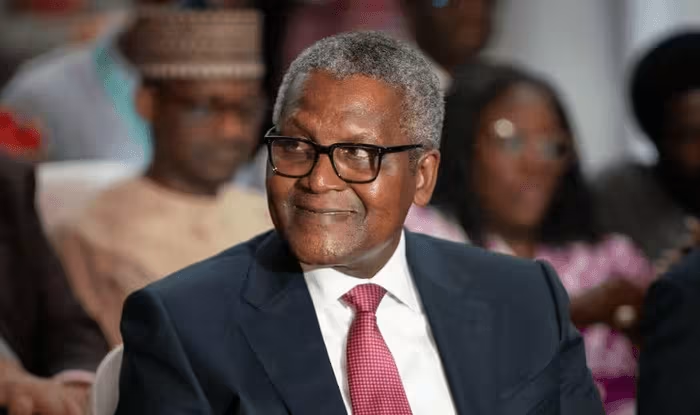
President and Chief Executive Officer of the Dangote Group, Aliko Dangote, has reaffirmed the company’s commitment to investing in Nigeria’s critical infrastructure, revealing that the conglomerate is currently executing 12 road projects valued at about ₦3 trillion under the Federal Government’s Infrastructure Tax Credit Scheme.
Dangote disclosed on Monday during the flag-off of the rehabilitation of the Bama–Banki and Dikwa–Gamboru Ngala roads in Borno State by President Bola Tinubu, who was represented by Vice President Kashim Shettima.
The road projects, awarded to Dangote Industries Nigeria Limited under the Infrastructure Tax Credit Scheme, are expected to improve security, reconnect communities affected by insurgency,y and stimulate economic activities across the Northeast. Dantata & Sawoe Nigeria Limited is serving as the subcontractor for the projects.
According to a statement issued by the Director of Information and Public Relations at the Federal Ministry of Works, Mohammed Ahmed, Dangote described the Infrastructure Tax Credit Scheme as a game-changing model for financing critical infrastructure, noting that it has enabled the private sector to play a more active role in national development.
He said quality roads and bridges are essential for driving economic growth, attracting investments, and promoting national prosperity, adding that the Dangote Group remains willing to undertake more infrastructure projects across the country.
Dangote also commended the Minister of Works, David Umahi, describing him as “a conqueror” for his dedication to delivering critical infrastructure projects nationwide.
Speaking at the event, President Tinubu said the rehabilitation of the Bama–Banki and Dikwa–Gamboru Ngala roads aligns with his administration’s commitment to restoring strategic infrastructure, enhancing security, and unlocking economic opportunities in the Northeast.
The President noted that the roads would strengthen connectivity with neighbouring Cameroon and the Republic of Chad, expand cross-border trade, and improve the movement of people, goods, and services across the region.
He added that the projects would also support the socio-economic recovery of communities devastated by years of insurgency while fostering regional integration and sustainable development.
Tinubu urged contractors and stakeholders to work closely with host communities to ensure the successful and timely completion of the projects, assuring Nigerians that his administration would continue prioritising infrastructure capable of driving economic growth and national development.
Minister of Works David Umahi described the projects as another milestone in the Federal Government’s infrastructure renewal programme, noting that they form part of four legacy infrastructure projects spread across Nigeria’s six geopolitical zones.
According to him, the projects are designed to improve regional connectivity, reduce travel time, facilitate trade and strengthen economic integration with neighbouring countries.
Minister of State for Works Bello Goronyo said the roads would deliver far-reaching economic, security, healthcare and tourism benefits, describing them as strategic investments that would improve livelihoods and deepen regional integration.
Chairman of the Senate Committee on Works, Senator Allwell Onyesoh, and Chairman of the House of Representatives Committee on Works, Akin Alabi, also lauded the partnership between the National Assembly and the Ministry of Works, describing the projects as evidence of the Federal Government’s commitment to inclusive infrastructure development.
Borno State Governor Babagana Zulum said the rehabilitation of the roads would accelerate the Northeast’s economic recovery by strengthening commercial ties with Cameroon and Chad while enhancing peace, security, and economic activities in the region.
Also speaking was the Shehu of Dikwa, who represented the Chairman of the Borno State Council of Traditional Rulers, Alhaji Abubakar Ibn Umar Garbai El-Kanemi, who welcomed the projects and pledged the support of traditional institutions to ensure their successful execution.
