

By Deborah Nnamdi
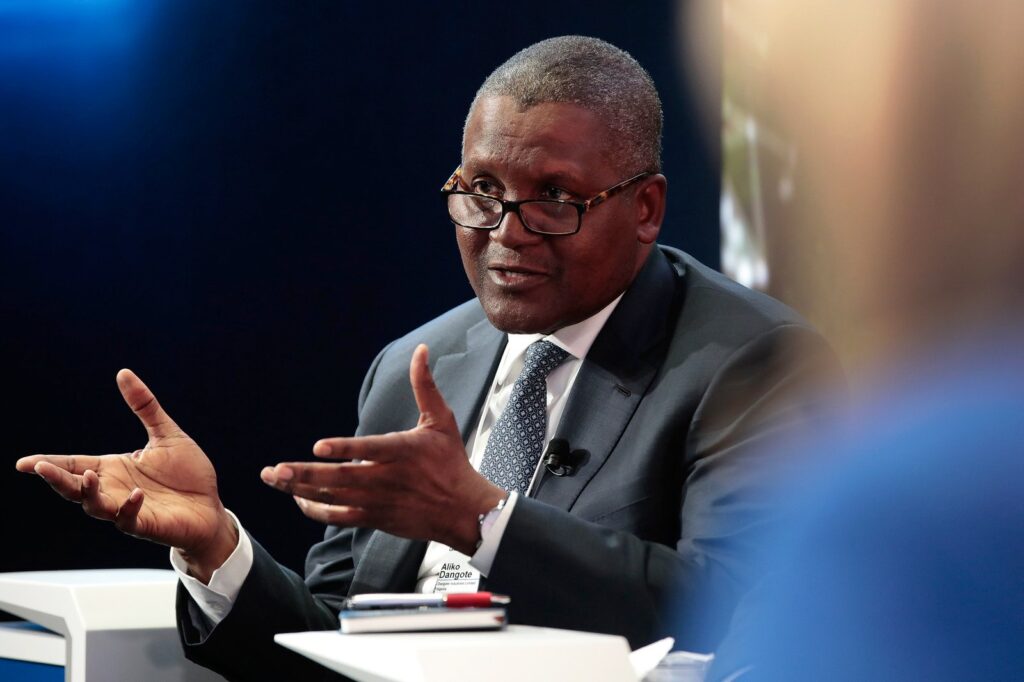
The net worth of Africa’s richest man, Aliko Dangote, has climbed to a record $36.7 billion, according to real-time Bloomberg data, further cementing his position as the wealthiest black person in the world and Africa’s richest individual.
The surge in wealth is largely attributed to the growing value of his industrial empire, particularly the $20 billion Dangote Refinery in Lagos and the continued strong performance of Dangote Cement. The billionaire’s business interests also span sugar, fertilizer production and other key sectors of the economy.
The Lagos-based refinery has emerged as a major force in Africa’s energy sector, supplying refined petroleum products to several countries across West Africa, including Côte d’Ivoire, Cameroon, Ghana, Togo and Tanzania. Industry observers say the development has strengthened foreign exchange earnings for the group as exports increasingly generate hard currency revenue.
The company is also making progress toward a planned Initial Public Offering (IPO) of the refinery, expected later this year. Market analysts believe the listing could unlock significant value and further boost the valuation of the business.
As part of its long-term expansion strategy, Dangote Industries has reportedly entered into a $400 million agreement with engineering firms to begin an ambitious programme aimed at doubling the refinery’s operational capacity by 2029.
The group is also investing heavily in petrochemicals, with plans to commence the production of linear alkyl benzene, a key ingredient used in detergent manufacturing. The project forms part of a broader industrial expansion programme valued at approximately $11.5 billion and supported by advanced technology partnerships.
Meanwhile, Dangote Cement continues to post impressive financial results, with profitability surpassing ₦1 trillion in a single financial year. The company remains the dominant player in Nigeria’s cement industry and is currently the most valuable firm on the Nigerian stock market, with a market valuation estimated at over ₦20 trillion.
The company’s strong market position has been reinforced by growing demand for construction materials across Africa, where rapid urbanisation and infrastructure development continue to drive consumption.
Beyond Nigeria, Dangote is accelerating investments across East Africa. The businessman has expressed commitment to leading an international consortium to establish a large-scale crude oil refinery in Tanga, Tanzania. Discussions involving the governments of Tanzania, Kenya and Uganda are said to be ongoing as stakeholders work toward formalising plans for the project.
In line with its continental expansion agenda, the group has also announced plans for a dedicated refinery designed to serve East Africa, contributing to its target of achieving a global refining capacity of up to 2.1 million barrels per day.
The conglomerate is equally advancing its footprint in agriculture and fertilizer production through a joint venture with Ethiopian Investment Holdings. The partnership is developing a $2.6 billion fertilizer plant in Ethiopia’s Somali Region, with projected annual production capacity of three million metric tonnes of urea. The facility is expected to become operational by 2029 and is anticipated to significantly enhance food security across the region.
To support the project, the company has secured a multi-billion-dollar gas supply agreement with Chinese energy giant GCL Group, ensuring stable feedstock supply for the fertilizer complex.
In another strategic move, Dangote is reportedly establishing a family office in Dubai to oversee international investments, wealth preservation initiatives and global asset management operations. The development is aimed at strengthening the management of the group’s growing international portfolio and protecting assets from currency volatility and macroeconomic risks.
Economic analysts say Dangote’s rise reflects the growing potential of industrialisation in Africa. By focusing on large-scale manufacturing and value-added production rather than raw commodity exports, the business empire has emerged as one of the continent’s most influential corporate success stories.
