

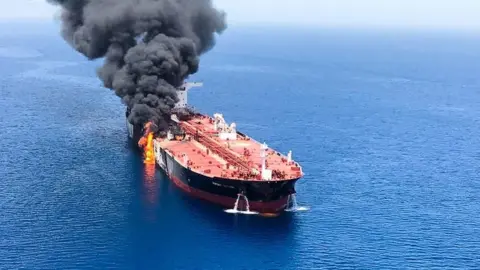
Oil prices surged above $100 per barrel on Monday as the Iran war entered its third week, with both sides showing no sign of backing down and diplomatic efforts intensifying to secure safe passage for tankers through the critical Strait of Hormuz.
Crude prices jumped in early trading after US President Donald Trump revealed over the weekend that American forces had struck military targets on Kharg Island, a key hub that handles the bulk of Iran’s oil exports. He warned that attacks could expand to energy infrastructure if Tehran interferes with transit through Hormuz, which has effectively been closed since US-Israel operations began on February 28.
However, Iran’s Fars news agency reported that no oil infrastructure was damaged in the strikes.
Trump called on other nations to deploy warships to ensure the waterway remains open, urging countries including China, France, Japan, South Korea, and the United Kingdom to take part. Writing on Truth Social, he said nations dependent on oil shipments through Hormuz “must take care of that passage,” adding that the United States would provide significant support.
Japan, however, said it was not currently considering a maritime security operation, while Australia ruled out sending naval vessels to the region.
Despite Trump’s claim that Tehran was seeking a deal to end hostilities, he said he was not prepared to negotiate under current conditions. Iran’s Foreign Minister, Abbas Araghchi, rejected talks with Washington, stating that Iran saw no reason to engage with the United States after being attacked.
“We were talking with them when they decided to attack us,” Araghchi said in an interview on CBS’s “Face the Nation.” He added that Iran had not sought a ceasefire or negotiations but was open to discussions with countries seeking assurances for the safe passage of their vessels.
Military exchanges continued on Monday. Saudi Arabia said it intercepted more than 60 drones since midnight, while flights were temporarily suspended at Dubai International Airport following a drone-related incident that sparked a nearby fire. Araghchi described Israeli strikes on fuel depots in Tehran as “ecocide,” citing potential long-term health risks.
Market hopes for a swift resolution dimmed after White House economic adviser Kevin Hassett said Pentagon estimates suggested the conflict could last up to six weeks, although operations were said to be ahead of schedule.
Both major crude benchmarks advanced. Brent Crude rose as much as three per cent to $106.50 before easing to around $104, while West Texas Intermediate traded just above $99 per barrel.
Japan announced it had begun releasing strategic oil reserves after the International Energy Agency indicated that a coordinated release would start in Asia and Oceania. IEA member states last week agreed to release a record 400 million barrels from stockpiles to help cushion price spikes triggered by the war.
Equity markets remained under pressure amid concerns of a looming energy crisis and its potential impact on the global economy. Shares fell in Tokyo, Shanghai, Sydney, Wellington, Taipei, Manila, and Jakarta, while Hong Kong, Seoul, Singapore, Mumbai, and Bangkok posted gains.
In Europe and the United States, markets also ended lower on Friday, with London’s FTSE 100 and Wall Street’s Dow Jones Industrial Average both closing in negative territory.
Analysts warned that the trajectory of energy prices would largely depend on when shipping through the Strait of Hormuz resumes. Prolonged disruption could tighten commodity supplies further, stoke inflation, and weigh on global growth.
Additional economic data added to concerns. Revised figures showed US fourth-quarter economic growth slowed to 0.7 per cent, down from an initial estimate of 1.4 per cent, while the Federal Reserve’s preferred inflation gauge eased to 2.8 per cent in January before energy prices accelerated.
Investors are also monitoring policy meetings this week at several major central banks, including the US Federal Reserve, the Bank of England, and the European Central Bank. While rates are expected to remain unchanged, markets will be watching closely for any comments on the war’s economic impact.
At around 0700 GMT, West Texas Intermediate was up 0.6 per cent at $99.30 per barrel, while Brent North Sea Crude gained 1.5 per cent to $104.68.
