

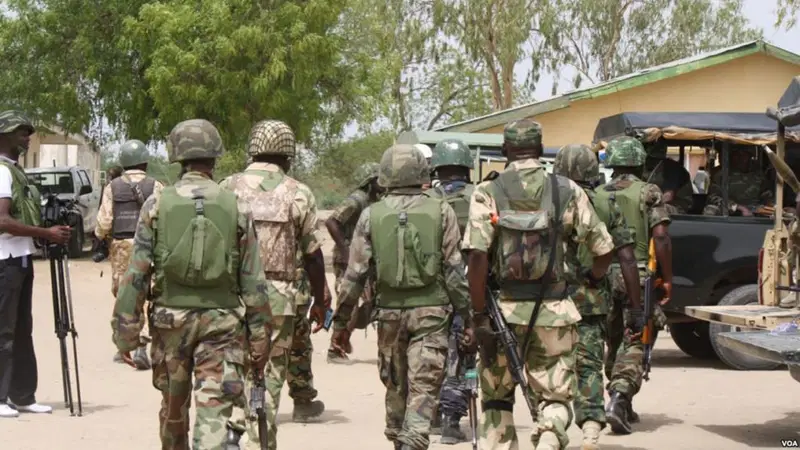
Troops of the Joint Task Force (North East), Operation HADIN KAI, have rescued 360 abductees from a heavily fortified Jama’atu Ahlis Sunna Lidda’awati wal-Jihad (JAS) enclave located in the Mandara Mountains of southern Borno State in what the military described as one of the most significant hostage rescue operations carried out in the North-East in recent times.
The successful operation was disclosed in a statement issued by the Acting Media Information Officer of Operation HADIN KAI, Lieutenant Colonel Haruna M. Sani, who said the mission was the result of weeks of intelligence gathering, covert surveillance, and detailed operational planning.
According to the military, the rescued victims, comprising men, women, and children, had been held under harsh conditions after being abducted from several communities, particularly within the Ngoshe axis of the state.
Lieutenant Colonel Sani said the operation was launched following credible intelligence from multiple sources that revealed the exact location of the hostages and exposed an extensive insurgent support network sustaining the enclave. He explained that intelligence personnel combined Human Intelligence, Signals Intelligence, and continuous Intelligence, Surveillance and Reconnaissance operations using unmanned aerial systems and long-range reconnaissance patrols to gather critical information about the area.
The military said the intelligence-driven approach enabled commanders to gain a comprehensive understanding of the terrain, insurgent positions, defensive structures, movement patterns, and the condition of the captives. This allowed troops to identify weaknesses within the terrorist network and significantly reduce risks to the hostages during the rescue mission.
A major breakthrough was reportedly achieved through intelligence assets that successfully penetrated the terrorist network and provided accurate information on the location of the abductees, the positions of insurgent commanders, internal security arrangements, and planned relocation routes. The military also said coordinated information and psychological operations created confusion and mistrust among the insurgents, weakening their command structure ahead of the assault.
Acting on the intelligence gathered, Special Forces and troops of Sector 1 launched a carefully coordinated multi-axis operation designed to isolate the objective area, secure strategic terrain, and block possible escape routes. Supported by real-time surveillance feeds, assault teams infiltrated the area under the cover of darkness while blocking forces positioned themselves along likely withdrawal paths.
The military said the operation achieved complete tactical surprise, overwhelming the terrorists before they could organise an effective response. Several insurgents reportedly fled into the surrounding mountainous terrain, while others surrendered as troops advanced on their positions.
The rescued hostages were immediately secured, medically screened, and evacuated from the area. However, the military disclosed that two infants died from exhaustion caused by the difficult mountainous terrain and the severe hardships endured during their prolonged captivity. The remaining victims were successfully moved to safe locations where they are receiving medical care and humanitarian assistance.
The Military High Command commended the courage, professionalism, and discipline displayed by personnel involved in the operation, describing the rescue as evidence of the effectiveness of intelligence-led operations and improved collaboration among security agencies. It reaffirmed the commitment of the Armed Forces of Nigeria to protecting citizens and restoring peace in communities affected by insurgency.
The military also assured the public that follow-up clearance operations are ongoing to neutralise remaining terrorist elements, dismantle support networks, and prevent future abductions.
Meanwhile, the Borno South Youth Alliance confirmed that all abductees from Ngoshe were released on Saturday night. Speaking via telephone, the group’s president, Samaila Ibrahim-Kaigama, disclosed that four babies born in captivity died from infections, while their mothers are currently receiving treatment at a government medical facility.
The group welcomed the release of the women and children, describing their return as a source of hope, joy, and relief for communities in Southern Borno. It also called on the Federal Government, Borno State Government, and relevant local authorities to conduct thorough screening and provide adequate support for the rescued victims as they begin the process of recovery and reintegration.
