

Photo: Think Business Africa Report
President Bola Tinubu is not the largest borrower among Nigeria’s democratically elected presidents since 1999, according to a new report released by economic policy research firm Think Business Africa.
The report, titled “Who Borrowed Most? Nigeria’s Presidential Debt Record 1999–2025,” challenged widespread claims that the current administration has accumulated more debt than all previous governments combined. It argued that such assertions fail to account for key economic factors, particularly the impact of exchange rate reforms on Nigeria’s existing foreign debt obligations.
According to the report, a substantial portion of the increase recorded in Nigeria’s debt stock since 2023 stems from the revaluation of inherited foreign currency debts following the liberalisation and unification of the foreign exchange market, rather than from fresh borrowing.
The research firm noted that while the country’s debt burden remains a major fiscal concern, the more pressing challenge is the rising cost of debt servicing, which continues to limit government spending on critical sectors such as infrastructure, healthcare, education, and social development.
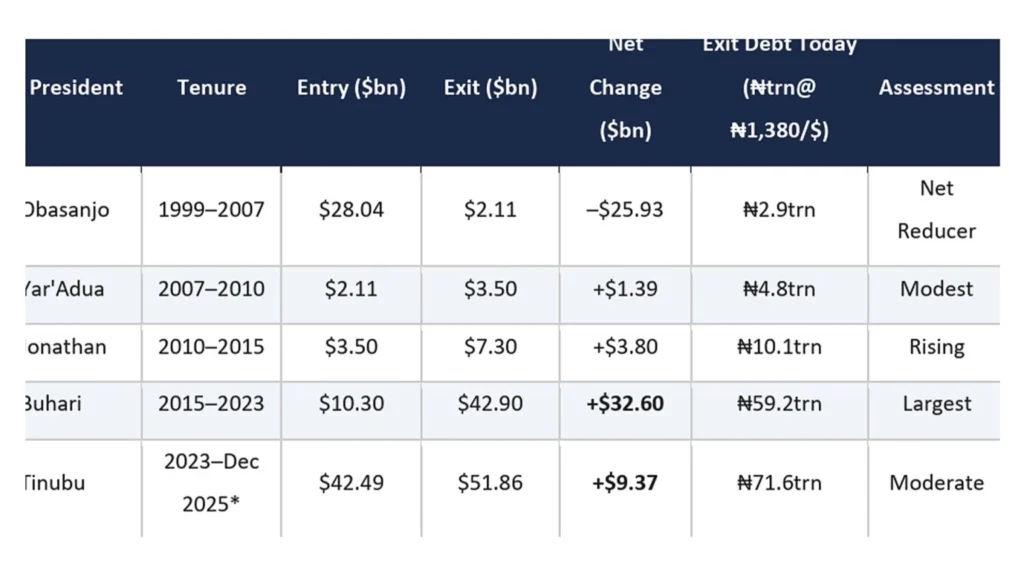
Citing official debt data, the report stated that Nigeria’s external debt stood at approximately $42.5 billion when Tinubu assumed office in May 2023. By December 2025, the figure had increased to about $51.9 billion, representing a net rise of roughly $9.4 billion.
In comparison, external debt reportedly rose from about $10.3 billion in 2015 to approximately $42.9 billion by 2023 during the administration of former President Muhammadu Buhari, reflecting a net increase of around $32.6 billion.
The report further observed that former President Olusegun Obasanjo remains the only democratic leader since 1999 to have significantly reduced Nigeria’s external debt stock, cutting it by an estimated $25.9 billion between 1999 and 2007.
Think Business Africa explained that assessing debt solely in naira terms can create a distorted impression because a significant portion of Nigeria’s obligations is denominated in foreign currencies. Following the exchange rate reforms introduced in June 2023, the naira depreciated sharply against the US dollar, causing the local currency value of existing external debts to rise substantially even without corresponding new borrowing.
The report noted that an inherited external debt stock of about $42.5 billion, previously valued at roughly N19.6 trillion under the former exchange rate regime, appeared significantly larger after the currency adjustment.
It also highlighted that domestic debt figures were affected by the securitisation of approximately N23.9 trillion in Ways and Means advances accumulated under previous administrations. According to the report, when exchange rate effects and accounting adjustments are excluded, the level of new borrowing under the current administration is considerably lower than headline naira debt figures suggest.
The analysis further revealed that domestic debt, when measured in dollar terms, declined by about $6.5 billion between the first quarter of 2023 and the end of 2025, while total public debt increased by only about $2.7 billion during the same period.
Despite these findings, the report acknowledged that Nigeria’s overall debt profile continues to pose economic challenges and stressed the need for prudent fiscal management to ensure debt sustainability and reduce pressure from rising debt-service obligations.
