

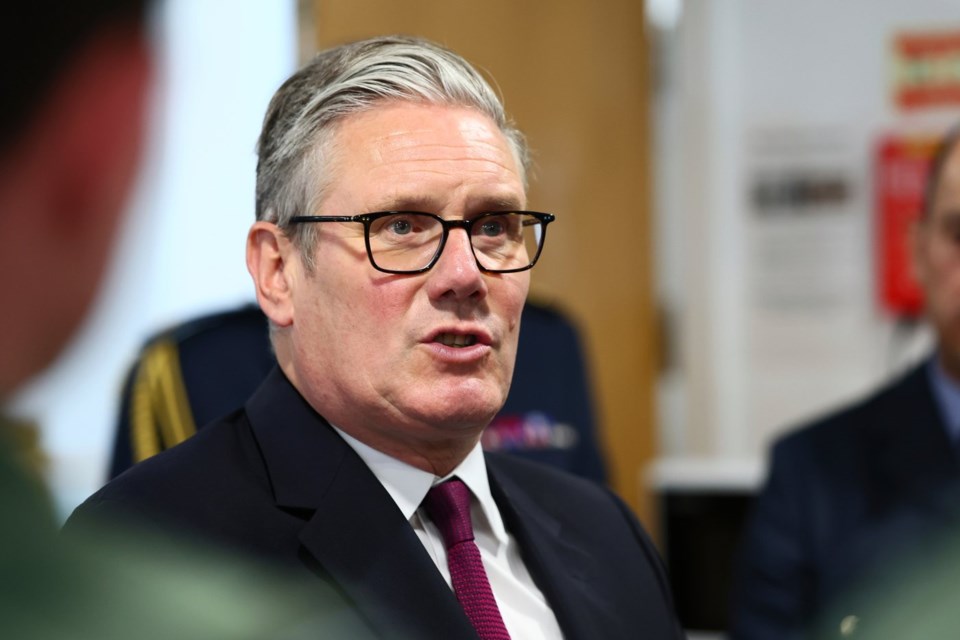
Photo: Andy Burnham could be PM after Keir Starmer’s resignation
By Oghenekevwe Kofi
Keir Starmer’s resignation as prime minister marks another abrupt change at the top of British politics, extending a period of leadership instability that has become one of the defining features of the post-Brexit era.
Less than two years after leading Labour to a decisive general election victory, Starmer has announced he will step down, becoming the sixth prime minister to leave office since David Cameron resigned following the 2016 Brexit referendum. Britain is now preparing for its seventh prime minister in a decade.
The speed with which leaders have come and gone would once have seemed improbable in a political system often held up as a model of continuity. For much of the post-war period, British prime ministers typically remained in office for years, shaping governments and defining political eras. Margaret Thatcher governed for more than 11 years, Tony Blair for a decade, while David Cameron appeared poised for a similarly lengthy premiership before the referendum transformed British politics.
Since then, however, Downing Street has become a revolving door. Keir Starmer’s resignation is the latest.
Theresa May was unable to secure parliamentary support for her Brexit deal and resigned after years of political deadlock. Boris Johnson delivered Britain’s withdrawal from the European Union but was forced from office after a succession of scandals and ministerial resignations. Liz Truss lasted just 49 days after financial markets reacted sharply to her government’s economic programme. Rishi Sunak inherited a divided Conservative Party and led it to defeat at the 2024 general election. Starmer, elected on a promise of stability and competent government, has now become the latest leader unable to secure a prolonged tenure.
| Prime Minister | Years in Office | Reason for Leaving |
|---|---|---|
| David Cameron | 2010–2016 | Resigned after the Brexit referendum |
| Theresa May | 2016–2019 | Unable to resolve the Brexit impasse |
| Boris Johnson | 2019–2022 | Resigned following political scandals and party revolt |
| Liz Truss | Sept.–Oct. 2022 | Economic turmoil after the mini-budget |
| Rishi Sunak | 2022–2024 | Defeat at the general election |
| Keir Starmer | 2024–2026 | Resigned amid mounting pressure within Labour |
| Successor | 2026– | Andy Burnham? |
The pattern raises broader questions than the fate of any individual prime minister. Britain has long prided itself on political stability, underpinned by strong institutions and an unwritten constitution that has generally allowed governments to manage transitions without upheaval. While those institutions remain intact, the frequency of leadership changes suggests that governing has become increasingly difficult.
Brexit remains central to understanding this shift. The referendum did more than redefine Britain’s relationship with the European Union; it fractured political parties, deepened ideological divisions and placed successive governments under sustained pressure. Cameron fell because he called the referendum. May could not deliver a Brexit settlement acceptable to Parliament. Johnson completed Britain’s departure from the EU but was ultimately undone by questions of conduct rather than policy.
Yet attributing Britain’s political volatility solely to Brexit risks overlooking wider structural changes.
Prime ministers now govern in an environment shaped by relentless media scrutiny, permanent campaigning and instant public reaction. Social media accelerates political crises, while 24-hour news coverage magnifies mistakes that might once have faded from public attention. Leadership authority has become more fragile, particularly when governing parties hold restless parliamentary majorities or face declining public support.
At the same time, governments confront a series of long-term challenges that offer few quick political rewards. Economic growth has remained subdued, public services continue to face significant pressures, housing affordability has deteriorated, immigration remains politically contentious and living standards have yet to recover fully for many households following successive economic shocks. These are problems that cannot be resolved within months, yet electoral politics increasingly demands immediate results.
The consequence is a widening gap between public expectations and governments’ capacity to deliver. Prime ministers often arrive in office with ambitious mandates, only to discover that the constraints of government- economic, institutional and political leave little room for rapid transformation. Public patience diminishes, internal party dissent grows, and leadership authority can erode with remarkable speed.
Starmer’s resignation is particularly significant because it suggests this pattern is no longer confined to the Conservative Party. Labour’s victory in 2024 was widely interpreted as an opportunity to restore political stability after years of Conservative upheaval. If Labour has also proved vulnerable to rapid leadership turnover, the issue may lie less with individual parties than with the pressures confronting modern government itself.
Britain is not experiencing a constitutional breakdown. Parliament continues to function, elections remain competitive, the judiciary retains its independence, and the machinery of government continues to operate. Leadership changes, however, carry costs. They interrupt long-term policymaking, create uncertainty for businesses and investors, and can weaken public confidence in political institutions.
The Labour Party will now begin the process of selecting a new leader, and attention will inevitably turn to who succeeds Starmer. But the larger question extends beyond the identity of the next occupant of No 10.
Why has it become so difficult for British prime ministers to endure?
Until that question is answered, the succession of leaders may continue, even as the country’s institutions remain resilient. The office of prime minister retains its authority. What appears increasingly uncertain is the ability of any individual to hold it for long.
