

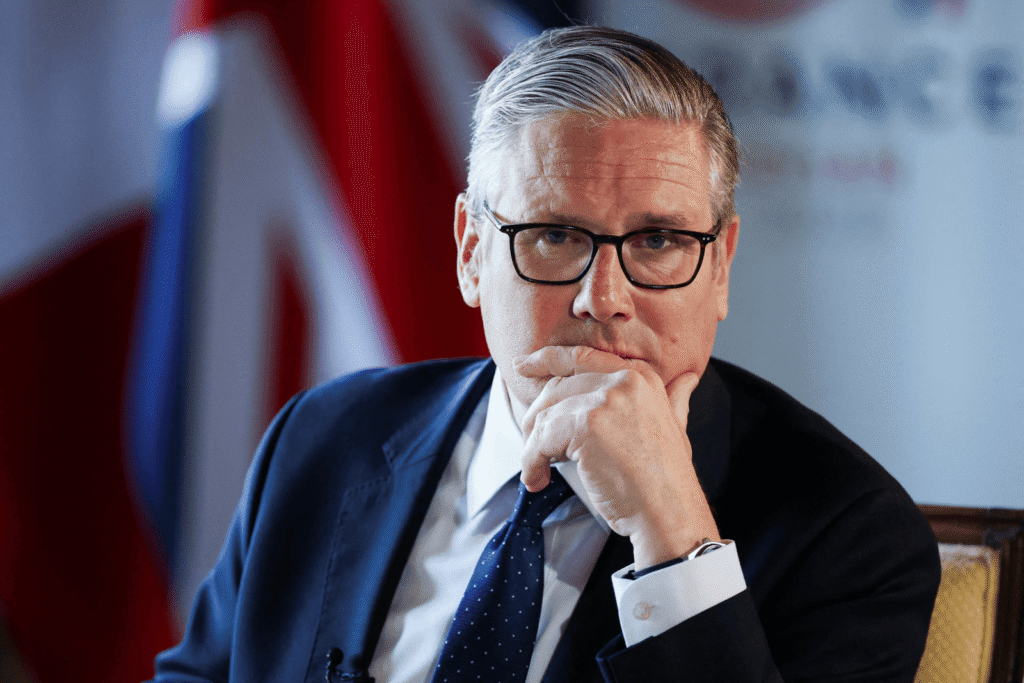
Photo: Britain’s Prime Minister, Keir Starmer
By Gabriel Efe
Political leaders often believe they inherit power. In reality, they inherit unfinished decisions.
There is a peculiar ritual in British politics.
A Prime Minister stumbles. The party begins to whisper. Names start circulating. Ambitious politicians who were once loyal suddenly discover that they have “concerns” about the direction of the government.
The language is always familiar.
Leadership.
Renewal.
A fresh start.
A chance to rebuild trust.
But beneath the carefully chosen words lies an old political truth: in Westminster, every senior politician secretly dreams of occupying the top seat.
The problem is that the office of the British Prime Minister has become less a destination of power and more a room filled with unfinished business.
The cartoon of the “Brexit graveyard” captures this perfectly. It shows former leaders walking past political tombstones, each carrying the weight of promises, failures, and explanations. It is funny because it exaggerates reality. It is uncomfortable because the joke is not entirely a joke.
The names change. The argument remains.
The question Britain has avoided is not simply: Who should lead next?
The deeper question is: What direction is Britain actually trying to move toward?
The beginning of this political journey was the referendum called by David Cameron in 2016.
A decision intended, at least politically, to settle an internal argument within the Conservative Party became a historic turning point for the United Kingdom.
Coming shortly after the Scottish independence referendum of 2014—when questions of identity, sovereignty, and belonging were already dominating the national conversation—Brexit was another attempt to answer a complicated question with a simple vote.
But nations rarely escape complicated realities through simple choices.
The promise was that leaving the European Union would allow Britain to take back control.
Control of its borders.
Control of its laws.
Control of its future.
Yet the years that followed revealed the difficult reality of separation. Leaving a major political and economic bloc was not simply a declaration of independence. It was a negotiation with geography, history, and economics.
Britain did not move away from Europe.
It moved away from a formal political structure while remaining tied to the same continent.
That is the paradox at the heart of Brexit.
Europe itself is not without challenges. The European Union has its own debates, bureaucracy, and internal tensions. Many European nations are grappling with changing demographics, migration pressures, economic competition, and shifting global power.
But one reality remains: Europe’s strength has always been rooted in cooperation.
In a world where the United States, China, and other emerging powers operate on a continental scale, smaller nations increasingly discover that isolation comes at a cost.
The irony is that while some nations within the European Union continue to pursue narrower national interests, history suggests that fragmentation weakens collective influence.
The answer for Europe may not be greater separation.
It may be a renewed sense of togetherness.
A Europe confident enough to reform itself—and perhaps humble enough to recognise that the United Kingdom’s return would strengthen the wider project.
Because Britain’s current political turbulence is not only a British problem.
It is a warning.
A nation can change its leader many times and still remain stuck if it refuses to confront the original decision that created the crisis.
A new Prime Minister cannot permanently outrun Brexit.
A new government cannot endlessly rearrange the furniture in a house whose foundation is still being questioned.
The British political class may need to rediscover something beyond ambition: honesty.
The difficult conversation is not about who gets the keys to Number 10 next.
It is about whether the journey that began with Brexit has delivered the destination that was promised.
This is also a lesson for nations watching from afar.
In a world increasingly tempted by isolationism, countries must ask whether standing alone always means standing stronger.
The United States, South Africa, and other nations navigating their own political and economic crossroads can learn from Britain’s experience.
Sovereignty matters.
Identity matters.
National pride matters.
But cooperation matters too.
No country, however powerful, exists in isolation.
Even an island nation eventually discovers that the tides of the world still reach its shores.
