

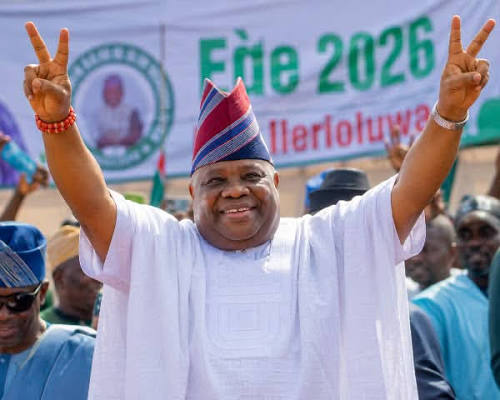
The dust has hardly settled on the Osun governorship election, but one thing is already clear: the APC did not lose the election to Ademola Adeleke alone. It lost to a combination of its own mistakes, the mood of the electorate, Adeleke’s political strategy and a campaign that understood the emotional temperature of Osun better than its opponent.
Adeleke polled 511,067 votes against Bola Oyebamiji’s 444,815, and both won 19 and 11 of the state’s 30 local government areas respectively.
Senator Babafemi Ojudu, an APC chieftain, has offered perhaps the most brutally honest postmortem so far. His list of those who defeated the APC included hunger, the freezing of the state government’s accounts, controversial statements attributed to Senator Fadahunsi, Wole Oke’s excessive invocation of President Tinubu’s name and power, Ero Arike’s rants, former Governor Gboyega Oyetola’s role in the emergence of the APC candidate, the invasion of Osun by national party leaders, Adeleke’s famous dancing, Davido’s popularity, the governor’s projects inauguration the resilience of Osun voters, campaign songs, Adeleke’s debate preparation and his media team.
Ojudu’s intervention is important because it comes from inside the house. It suggests that the APC’s defeat cannot simply be explained away as electoral manipulation or the superior financial muscle of the opposition. There were strategic errors. There was also a failure to appreciate the extent to which Adeleke had transformed himself from merely being a governor into a political brand. He was not selling Accord to the voters. He was selling himself.
The APC also had a candidate selection problem. Oyebamiji may be a competent politician, but elections are not examinations in competence. They are contests in perception, connection and mobilisation. The decision to rally around a candidate without completely resolving the internal political grievances within the party created a vulnerability that Adeleke exploited. The Osun APC had already been described as deeply divided, while the election itself had become a test of President Bola Tinubu’s influence and the ability of the ruling party to manage competing interests.
Then came the politics of federal power. Bringing governors, senators and other national figures into Osun was intended to demonstrate strength. Instead, it may have strengthened Adeleke’s narrative that Osun was being invaded by Abuja. Politics is sometimes about what you intend to communicate and what the people actually hear. The APC wanted to say, “We have the government at the centre.” Many voters may have heard, “The people from Abuja have come to take your state.”
Adeleke, meanwhile, played the local card exceptionally well. His projects became campaign materials. His dancing became a cultural trademark. His personality made him accessible. His commissioning ceremonies gave him opportunities to appear before traditional rulers and communities. His media team ensured that these moments travelled beyond the physical locations where they occurred. His debate performance also helped challenge the old caricature of Adeleke as a politician whose greatest asset was his dancing ability.
And then there was Davido. It would be simplistic to say that Davido delivered the election to his uncle, but it would equally be foolish to pretend his influence did not matter. He brought enormous visibility, especially among younger voters, and turned the election into something larger than a conventional political contest. His interventions during the election itself demonstrated how celebrity influence and social media have become part of Nigeria’s electoral machinery.
Another decisive factor was the fragmentation of the opposition vote. The ADC’s Najeem Salam was a significant factor, while other political movements and individuals eventually tilted toward Adeleke. Former PDP aspirant Adedamola Adebayo, for instance, withdrew and endorsed Adeleke shortly before the election. Former APC national secretary Iyiola Omisore had also moved his political structure in support of Adeleke months earlier. These developments helped consolidate the anti-APC vote around the incumbent.
But perhaps the most important factor was the Osun voter. The people were not merely spectators in this election. They had their own assessment of the economy, Adeleke’s performance, the APC, the federal government and the competing personalities. In the end, they voted. And they voted decisively.
The lesson for the APC is therefore uncomfortable but necessary. It was not defeated by Adeleke’s dancing, Davido’s campaign songs, or even one controversial politician. Those were the ingredients. The real defeat came from a failure to read the mood of the people and a failure to manage its own house.
Osun has delivered a simple message to Nigerian politicians: power in Abuja is not the same thing as acceptance in the villages, towns and polling units. You can bring the biggest political heavyweights into a state and still lose to a man dancing on a campaign stage.
The people, ultimately, decide who wins. And in Osun, they have spoken.
