

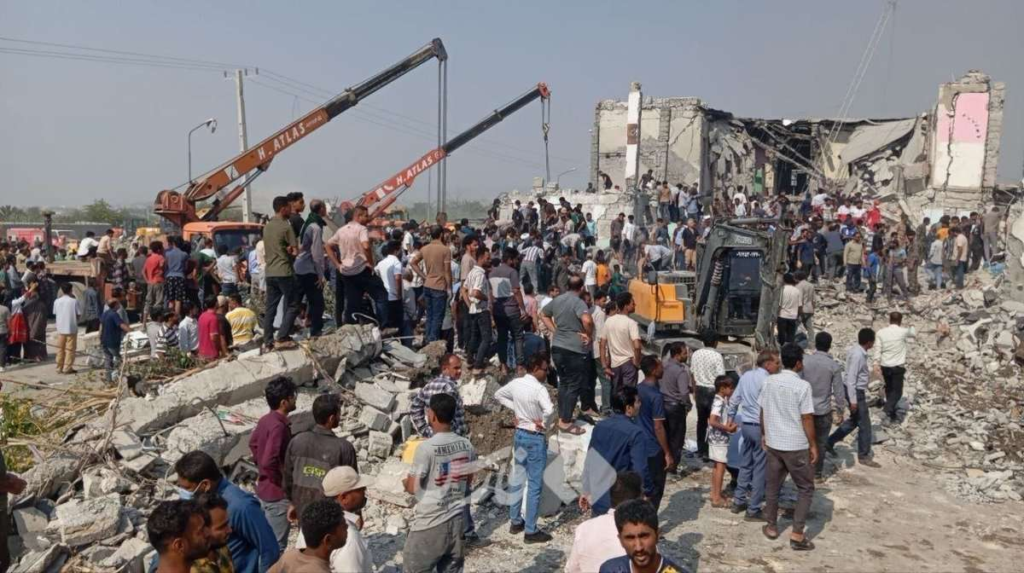
Photo: A scene from the killing of 175 girls and teachers in Tehran school bombing
After 100 days of war, the US and Iran have met at a round table. Wars rarely end with clear victors, not even one by the world’s most powerful nation. More often, they conclude with exhausted adversaries accepting a compromise that, months earlier, would have been politically unthinkable. The MU signed to end the conflict that erupted on 28 February appears to be one such moment.
For more than 100 days, the world watched as fears of a regional war escalated into reality. Air strikes devastated military installations and civilian infrastructure. Global oil markets convulsed. Commercial shipping through the Strait of Hormuz slowed under the shadow of missile attacks and naval confrontation. Diplomats warned that a conflict once considered containable threatened to redraw the strategic map of the Middle East.
Now, the guns have fallen silent. The silence should not be mistaken for victory, certainly not by Donald Trump.
The agreement offers immediate relief to a region desperate for stability, and a world crying for economic equilibrium. The shipping lanes are reopening, energy markets are calming, and the prospect of renewed diplomacy has reduced the risk of an even wider conflagration. Yet the ceasefire also invites a more uncomfortable question: after months of destruction, who actually emerged stronger?
The answer is complicated.
IRAN, despite suffering extensive military and economic damage, may well be the conflict’s principal strategic survivor and victor. It endured sustained bombardment, lost its Supreme Leader, Ayatollah Ali Khameni, senior military commanders, scientists and key infrastructure, yet the central objective many believed Washington and its allies sought, which is a fundamental regime change or the collapse of Iran’s strategic posture, never materialised.
Instead, Tehran enters negotiations with its government intact, its political system preserved and its regional influence diminished but far from eliminated. The agreement reportedly opens the door to sanctions relief, the release of frozen assets and renewed economic engagement while postponing, rather than permanently resolving, the most contentious questions surrounding its nuclear programme.
That is not the outcome many expected when the first missiles were launched.
WORLD: The global economy is another quiet beneficiary. The reopening of the Strait of Hormuz eases one of the world’s most significant geopolitical choke points. Lower shipping risks, more predictable oil supplies and improved investor confidence are likely to soften inflationary pressures already weighing heavily on many economies. For countries with no stake in the conflict beyond energy security, peace itself represents a strategic dividend.
USA: The United States may also point to tangible achievements. Washington compelled Iran back to negotiations after demonstrating overwhelming military superiority. It secured renewed commitments against nuclear weaponisation and avoided the political nightmare of becoming trapped in another open-ended Middle Eastern war.
But these successes carry an undeniable cost.
The United States expended billions of dollars in military operations, precision-guided munitions, naval deployments and logistical support. It consumed strategic resources at a time when it faces simultaneous security challenges in Europe and the Indo-Pacific. More importantly, the conflict exposed the limits of military power as an instrument of political transformation.
After more than three months of warfare, Washington accepted an agreement that resembles, in broad terms, the kind of negotiated framework diplomacy had long sought to achieve. Iran’s government remains in power. Its nuclear ambitions are deferred rather than extinguished. Its regional influence has been weakened and its reputation as the defenders of human rights battered, especially from the heinous Tomahawk bombardment of a girls’ school, killing 175 teenager girls and teachers. Although Trump said the attack was not on purpose, the image of charred body parts, school bags and toys remain at emblem of US and the war.
For critics, this raises a difficult question: if negotiations were always the inevitable destination, was the cost of war proportionate to the outcome?
The conflict also exacted a diplomatic price. Differences emerged among allies over military strategy, humanitarian consequences and the terms of the settlement. The war has renewed domestic debate within the United States over the financial and political sustainability of prolonged military engagement in the Middle East, particularly at a time when American strategic priorities are increasingly shifting elsewhere.
Iran’s own losses, however, should not be understated.
Its economy has suffered profound damage. Military facilities, industrial infrastructure, transportation networks and energy installations have been severely degraded. Senior commanders and scientists are dead. Thousands of soldiers and civilians have lost their lives. Reconstruction will require years, perhaps decades, and the economic burden will fall on a population already strained by sanctions and inflation.
Survival should not be confused with prosperity.
Israel also emerges with mixed results. It demonstrated formidable military capabilities and defensive resilience under sustained missile and drone attacks. Yet the broader strategic objective of permanently neutralising Iran as a regional threat remains unrealised. The financial cost of missile defence, infrastructure damage and prolonged mobilisation has been immense, while Iran remains a significant strategic competitor whose long-term ambitions have not disappeared.
The Gulf Arab states, meanwhile, have been reminded of an uncomfortable reality. Their prosperity depends upon stability that neither Washington nor Tehran alone can guarantee. Although they avoided becoming principal battlefields, disrupted trade, volatile energy markets and heightened security risks exposed the vulnerability of economies built upon uninterrupted regional commerce. The experience is likely to reinforce their growing preference for diplomacy over confrontation and for diversified security partnerships over exclusive reliance on any single external power.
Perhaps the greatest loser is not any individual state but the very notion of decisive military victory.
More than 100 days of conflict produced thousands of deaths, billions of dollars in destroyed infrastructure, severe humanitarian suffering and unprecedented economic disruption. Yet the issues that triggered the war, which is nuclear enrichment, sanctions, regional influence and security guarantees, remain fundamentally unresolved. They have merely migrated from the battlefield back to the negotiating table.
History offers many examples of wars launched with ambitious political objectives only to conclude with negotiated settlements neither side initially wished to contemplate. This conflict appears destined to join that list.
The Memorandum of Understanding should therefore be viewed neither as a triumph nor as a defeat for either side. It is better understood as a collective recognition that the costs of continued war had become greater than the concessions required for peace.
Whether this agreement marks the beginning of lasting regional stability or merely an intermission before another cycle of confrontation will depend not on the signatures affixed to the memorandum, but on whether the diplomacy that follows succeeds where more than one hundred days of military force ultimately failed.
If there is one enduring lesson from this war, it is that modern conflicts increasingly produce survivors rather than winners. The battlefield may settle immediate disputes, but lasting security is almost always negotiated. The real test begins not after the first missile is fired, but after the last one falls silent.
