

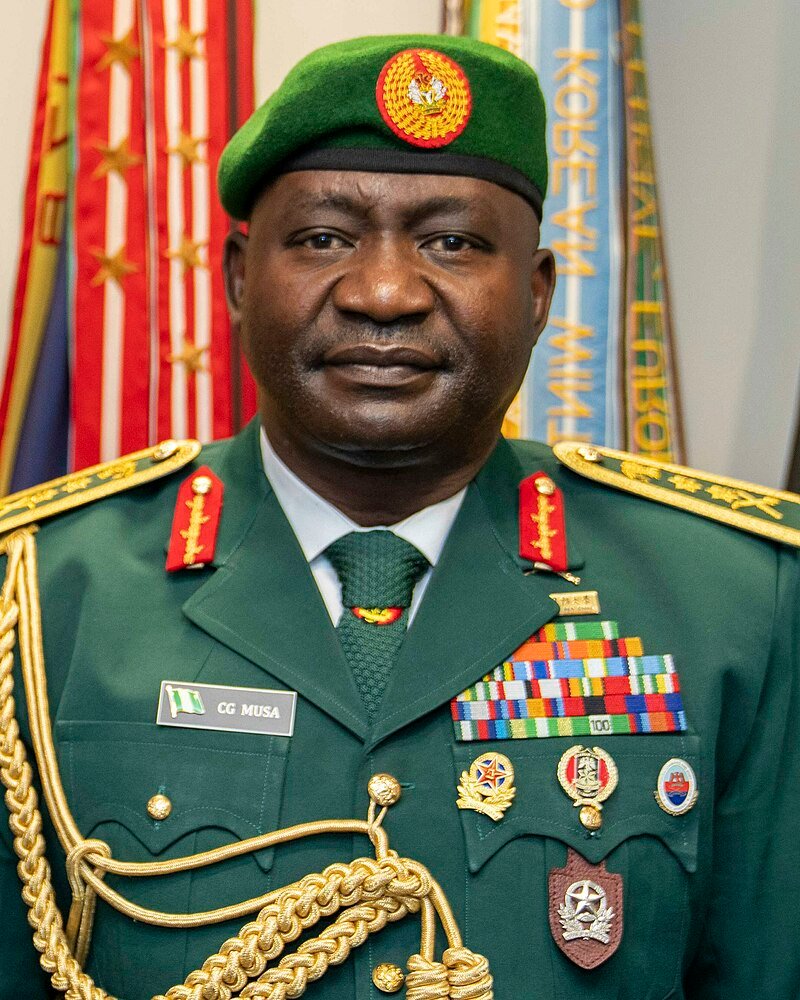
Nigeria’s Chief of Defence Staff, Christopher Musa, has rated the administration of President Bola Ahmed Tinubu between 65 and 70 per cent on security performance, insisting that terrorism across the country has been significantly reduced despite persistent kidnapping incidents.
Speaking on ARISE News on Friday to mark the administration’s third anniversary, Musa said no country was entirely free from crime and criminality.
“I’ll give ourselves 65 to 70 per cent,” he said. “The level of terrorism across the country has actually drastically reduced. Now we have acts of terrorism, and terrorism, like I said, is a social vice, a failure of family values.”
The defence chief described kidnapping as a broader societal problem linked to the breakdown of family structures rather than solely a security failure.
“We have fathers kidnapping children, children kidnapping each other, brothers kidnapping sisters. It tells you that something is wrong with the family, and we need to look inward to see how we can develop those aspects,” he said.
His comments come amid growing concerns over renewed school abductions across parts of the country.
At least 82 pupils were abducted between May 13 and 15 during separate attacks in Borno State and Oyo State.
In Borno, 42 pupils were kidnapped after armed men attacked schools in Askira Uba and Chibok local government areas on May 13 and 14.
In Oyo State, another 40 pupils were abducted on May 15 during coordinated attacks on Baptist Nursery and Primary School, Yawota; Community Grammar School; and L.A. Primary School in Oriire Local Government Area.
During the Oyo attack, a mathematics teacher identified as Michael Oyedokun was beheaded by the attackers, while a motorcyclist and a security operative were also killed during rescue efforts after encountering improvised explosive devices allegedly planted by the abductors.
The Defence Headquarters linked the Oyo incident to terrorists belonging to the JAS faction displaced from other regions due to intensified military operations.
Following the attacks in Borno, the state government temporarily shut and relocated Government Day Secondary School, Mussa, in Askira/Uba Local Government Area.
Amnesty International recently disclosed that at least 1,100 people were abducted between January and April 2026, describing the trend as evidence of continued failure to protect vulnerable communities.
The latest incidents add to a growing pattern of mass abductions nationwide. In April, gunmen kidnapped 23 pupils and the wife of a school proprietor during an attack on an orphanage and school facility in Zariagi, Kogi State.
Troops of the 12 Brigade of the Nigerian Army later rescued the remaining nine victims during operations conducted under Operation Tiger Paw II on May 6.
Nigeria also witnessed another spike in mass kidnappings in November 2025, when at least 145 people were abducted within four days across Kebbi, Niger and Zamfara states.
One of the incidents involved an attack on a government secondary school in Maga, Kebbi State, where bandits killed the vice principal and abducted 25 schoolgirls from their hostel.
Musa blamed greed and the desire for quick wealth for the growing wave of kidnappings.
“People need to understand that to make money, you must work very hard. Don’t look for shortcuts. Most of those taking part in kidnappings and related crimes are looking for shortcuts,” he said.
The defence chief also highlighted what he described as growing operational successes by the military, citing the recent elimination of a deputy ISIS commander after months of surveillance and intelligence gathering.
“The recent killing of that deputy ISIS commander was a painstaking operation that began since last year. We followed through, ensured we were certain of our target, and when we struck, we got them,” he said.
Musa added that security agencies were now receiving stronger support from Nigerians, which he said had improved operations across the country.
He also revealed that Nigeria was deepening cooperation with countries including the United States, Britain, France, Brazil and Turkey in its fight against terrorism.
“We are working with our partners, the Americans, the British, the French, all of them want Nigeria to succeed. They are bringing platforms we don’t have, and we are working together,” he said.
The defence chief warned against allowing terrorism to become entrenched, citing Turkey’s decades-long struggle with insurgency as a lesson for Nigeria.
“Do not allow acts of terrorism to take root. It is extremely difficult to reverse. Look at Turkey. It took them 40 years, and it is only now that they are getting over it,” Musa said.
