

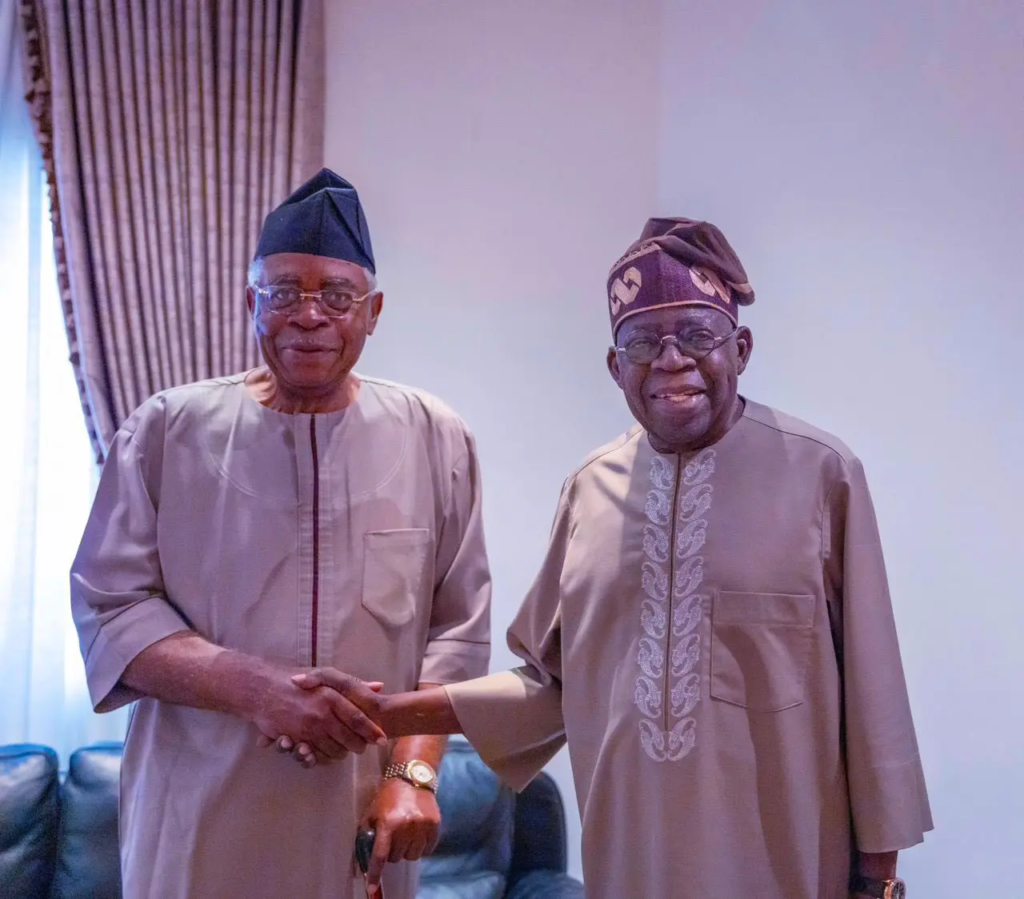
Photo: Tinibu and Gen TY Danjuma (retd) after the meeting
By Didimoko A. Didimoko, abuja
President Bola Ahmed Tinubu on Saturday received retired General Theophilus Yakubu Danjuma at the Presidential Villa in Abuja, in a meeting that has already sparked political interest beyond its official description.
The Presidency confirmed the visit in a brief statement accompanied by photographs, noting that the former Minister of Defence was received in audience at the State House. No details of the discussions were disclosed, leaving the purpose of the high-level engagement open to interpretation.
Danjuma is no ordinary visitor. A former Chief of Army Staff under the military administration of Olusegun Obasanjo and later Minister of Defence during Obasanjo’s civilian presidency, he remains one of Nigeria’s most influential elder statesmen. Beyond his military and political career, he is a respected businessman and philanthropist, widely known for his humanitarian interventions through the TY Danjuma Foundation.
In Nigeria’s political culture, meetings between a sitting president and a figure of Danjuma’s stature rarely pass as mere courtesy calls. Even in the absence of an official communiqué, such engagements are often interpreted as consultations on matters of national importance — particularly security and political stability.
Security remains one of the defining issues of Tinubu’s administration. With persistent challenges ranging from insurgency and banditry to communal violence, the president’s engagement with a former Defence Minister and military commander may signal behind-the-scenes consultations aimed at strengthening strategy or reviewing the nation’s security architecture. Danjuma has previously spoken publicly about security concerns in the country, and his perspective carries weight within both military and civilian circles.
Beyond security, the timing of the meeting inevitably feeds speculation about the 2027 general elections. Although the next presidential contest is still some distance away, political groundwork in Nigeria often begins years in advance. As an incumbent constitutionally eligible to seek re-election, Tinubu’s ability to consolidate elite support across regions will be central to his political calculations.
Danjuma, as a prominent Northern figure with deep networks in political, military and business communities, represents an important voice within the broader power structure. Engagement with such stakeholders can be seen as part of quiet consensus-building — a hallmark of Nigerian electoral politics. While there is no evidence that the discussion centered on electoral strategy, observers are likely to interpret the optics as part of early positioning within an evolving political landscape.
At the same time, the meeting could simply reflect routine consultation between a president and a respected national leader. In Nigeria’s governance structure, elder statesmen are often sought for advice on pressing national issues.
Whether focused on security reforms, national unity, or longer-term political alignments, the closed-door conversation underscores the intersection of governance and politics. As 2027 gradually enters the national conversation, even seemingly routine engagements will continue to be viewed through the dual lenses of policy and political strategy.
