

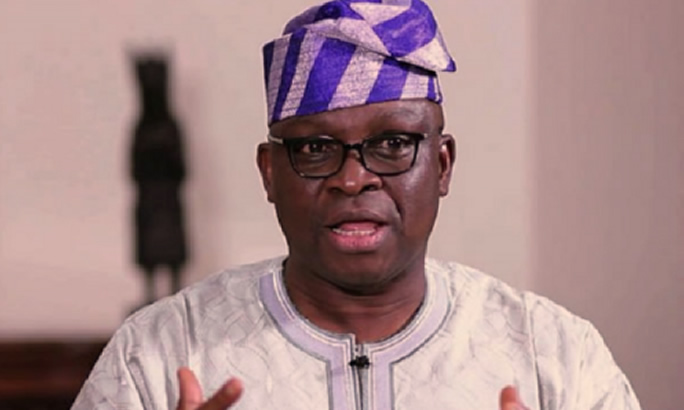
Photo: Former Ekiti State governor, Ayodele Fayose
By Deborah Nnamdi
A Federal High Court sitting in Lagos has discharged and acquitted former Ekiti State governor, Ayodele Fayose, of alleged money laundering and theft charges involving N6.9 billion.
Delivering judgment on Wednesday, Justice Chukwujekwu Aneke upheld a no-case submission filed by Fayose’s legal team, ruling that the Economic and Financial Crimes Commission (EFCC) failed to establish a prima facie case against the former governor.
The court found that the prosecution was unable to link Fayose to the alleged financial crimes or provide sufficient evidence to require him to enter a defence.
Fayose was first arraigned in 2018 before Justice Mojisola Olatoregun. The EFCC later sought and secured the transfer of the case to Justice Aneke. Alongside his company, Spotless Investment Ltd, Fayose faced 11 counts bordering on money laundering, criminal breach of trust, and theft.
The EFCC accused him of receiving N1.2 billion in 2014 to fund his gubernatorial campaign, as well as collecting $5 million in cash from the Minister of State for Defence, Musiliu Obanikoro, allegedly without passing through financial institutions. The agency also alleged that over N1.6 billion was laundered through companies, including De Privateer Ltd and Still Earth Ltd, for the acquisition of various properties.
At the hearing, Fayose’s lead counsel, Chief Kanu Agabi (SAN), argued that the EFCC failed to present credible evidence tying his client to the alleged crimes. Agabi further noted that Abiodun Agbele, who was reportedly involved in the financial transactions in question, was never charged alongside Fayose.
“With due respect, the predicate offences on which these charges are based do not hold water. Criminal breach of trust and conspiracy are distinct, and no co-conspirator was charged alongside the defendant,” Agabi submitted.
In his ruling, Justice Aneke agreed with the defence’s argument and dismissed all charges, effectively bringing the protracted legal battle to an end.
The EFCC is set to announce whether it will appeal the decision.