

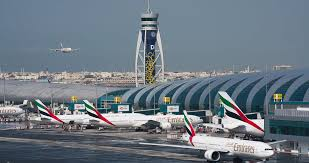
Airlines across the globe suspended flights through large parts of the Middle East on Saturday after military strikes by the United States and Israel against Iran triggered retaliatory missile attacks, plunging the region into renewed conflict and paralyzing one of the world’s busiest aviation corridors.
Flight tracking maps showed vast stretches of airspace over Iran, Iraq, Kuwait, Israel and Bahrain virtually empty as carriers rushed to reroute or cancel services. The disruption extended to and from Dubai, widely regarded as the world’s busiest international travel hub, sending shockwaves through global aviation networks.
Dubai operations suspended
Dubai Airports confirmed that all flights at Dubai International Airport, which handled nearly 100 million passengers last year, as well as at Al Maktoum International Airport were suspended until further notice. Authorities urged passengers not to travel to the airport.
“Due to multiple regional airspace closures, Emirates has temporarily suspended operations to and from Dubai,” said Emirates, while its sister carrier flydubai announced a similar halt in operations.
In neighboring Abu Dhabi, Etihad Airways said all departing flights were suspended until 1000 GMT Sunday, adding that inbound flights would be cancelled or diverted as necessary.
Explosions reported across Gulf
Witnesses reported explosions across several Gulf cities, including Doha in Qatar, which hosts the largest U.S. military base in the region. Blasts were also reported in Abu Dhabi and Dubai in the United Arab Emirates.
The escalation follows Israeli strikes on Iranian territory and subsequent U.S. military action, prompting Tehran to retaliate with missile salvos. The renewed confrontation has dimmed hopes of a diplomatic resolution to Iran’s nuclear dispute with Western powers and reignited regional tensions after weeks of military buildup.
Regional airspace closed
Countries including Israel, Iran, Iraq, Bahrain, Qatar, Kuwait and Jordan closed their airspace in the immediate aftermath of the strikes. A regional map from Flightradar24 showed aircraft diverting away from conflict zones, with traffic clustering around airports in Larnaca, Jeddah, Cairo and Riyadh.
The flight-tracking platform itself briefly experienced an outage due to a surge in global users seeking updates.
Eric Schouten, head of aviation security advisory Dyami, warned that the disruption could persist. “Passengers and airlines can expect airspace to be shut for quite some time in the region. The impact on regional aviation is immediate and highly fluid,” he said.
Airlines cancel and reroute
Preliminary data from aviation analytics firm Cirium indicated that nearly 40% of flights to Israel and 6.7% of flights to the broader region were cancelled on Saturday, with numbers expected to rise.
At Doha’s Hamad International Airport, gates appeared nearly empty as stranded passengers queued to arrange hotel accommodations. Uncertainty loomed over when flight schedules would normalize.
Major international carriers moved swiftly:
- British Airways cancelled flights to Tel Aviv and Bahrain until March 3 and suspended Saturday’s services to Amman.
- Lufthansa halted flights to and from Dubai for the weekend and suspended routes to Tel Aviv, Beirut and Oman until March 7.
- Air France cancelled flights to Tel Aviv and Beirut.
- Wizz Air suspended services to Israel, Dubai, Abu Dhabi and Amman.
- KLM brought forward the suspension of its Amsterdam–Tel Aviv route.
- Virgin Atlantic announced it would avoid Iraqi airspace, rerouting several flights.
Russian air carriers suspended services to Iran and Israel, while India’s aviation authority placed the country on alert to manage potential diversions as Air India and IndiGo halted affected routes.
Regional airlines including Qatar Airways, Kuwait Airways and Turkish Airlines also suspended multiple services.
Aviation industry under strain
The latest disruption compounds operational challenges that have intensified since the war between Russia and Ukraine forced carriers to avoid vast stretches of Eastern European airspace. Conflict zones are increasingly complicating flight planning, insurance costs and fuel consumption.
Longer routes to bypass high-risk areas require more fuel, increase crew costs and strain aircraft schedules. Airlines are also acutely aware of safety risks posed by aerial hostilities, including the possibility of accidental or deliberate shoot-downs of commercial aircraft.
The European Union’s aviation safety regulator, European Union Aviation Safety Agency, recommended airlines avoid affected airspace until further notice.
A critical global hub disrupted
Middle Eastern airports serve as essential transit hubs linking Europe, Asia and Africa. Dubai, Doha and Abu Dhabi are key connectors for long-haul intercontinental travel. With these hubs effectively frozen, global travel schedules face significant ripple effects.
Industry analysts warn that if airspace closures persist, passenger backlogs, rising ticket prices and widespread delays could follow. For now, airlines and passengers alike remain in a holding pattern — awaiting clarity in a region where events are unfolding rapidly.
The immediate priority remains safety. But as missiles fly and air corridors close, the disruption to global aviation underscores how swiftly geopolitical conflict can paralyze the arteries of international travel.