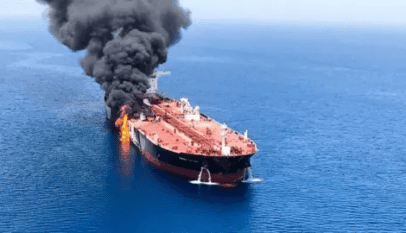

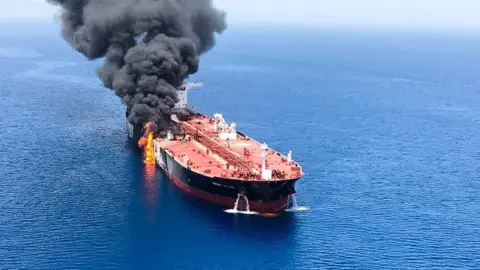
Photo: Tanker on fire in Gulf of Oman
By Douglas Maha, Abuja
Nigeria’s Foreign Minister Yusuf Tuggar has urged oil- and gas-producing nations in the Gulf to see Africa’s largest crude producer as a strategic partner rather than a rival, as tensions in the Middle East threaten global energy supply chains.
In an interview with Reuters, Tuggar said the ongoing conflict involving Iran has disrupted shipments through the Strait of Hormuz, a critical transit route for roughly a fifth of global oil supplies, contributing to export delays and sharp price volatility.
He said Nigeria has long advocated deeper cooperation with Gulf producers to help them diversify their market exposure through joint investments in Africa’s energy sector.
“It’s in line with what we’ve always advocated – that countries which might otherwise consider us competitors should partner with us and invest so they can diversify their market share, working with us,” Tuggar said.
Nigeria has increased crude output to about 1.7 million barrels per day (bpd) from around 1.4 million bpd when President Bola Tinubu took office in 2023, overcoming challenges including underinvestment, oil theft and pipeline vandalism, Tuggar said.
He added that fresh capital inflows into upstream projects and pipeline infrastructure could support further growth in production capacity.
While some analysts caution that escalating strikes between the United States, Israel and Iran — and Tehran’s retaliatory threats against Gulf energy assets — could delay investment flows into Africa, Tuggar said the crisis may instead encourage strategic partnerships.
“It could make them want to work with countries like Nigeria that are rich in gas and oil … to diversify market share for the benefit of both countries, or they could hold back,” he said.
Recent agreements suggest growing momentum. Nigeria and the United Arab Emirates signed a Comprehensive Economic Partnership Agreement in January aimed at boosting trade and investment, while investors linked to Qatar have also signalled interest in gas development projects in Nigeria, though timelines remain unclear.
Energy analysts, however, point to bureaucratic bottlenecks and project execution risks as key obstacles that could hinder the realisation of such investment pledges.
Tuggar acknowledged that higher global crude prices have also created domestic challenges for Nigeria, which still imports significant volumes of refined petroleum products. Rising fuel costs have pushed up transport and food prices, adding pressure on households during the Muslim fasting month of Ramadan, when consumption patterns typically shift.
He expressed optimism that the expansion of domestic refining capacity could cushion the impact over time, noting that the privately owned Dangote refinery is now operating at its full 650,000 bpd capacity, which he said is sufficient to meet local fuel demand.
Despite growing global focus on energy transition, Tuggar stressed that oil and gas would remain central to the world economy in the near term.
“At the moment the world consumes about 105 to 106 million barrels per day. I don’t see that changing much anytime soon, so we need to work together so we have enough hydrocarbons available,” he said.