
By Deborah Nnamdi
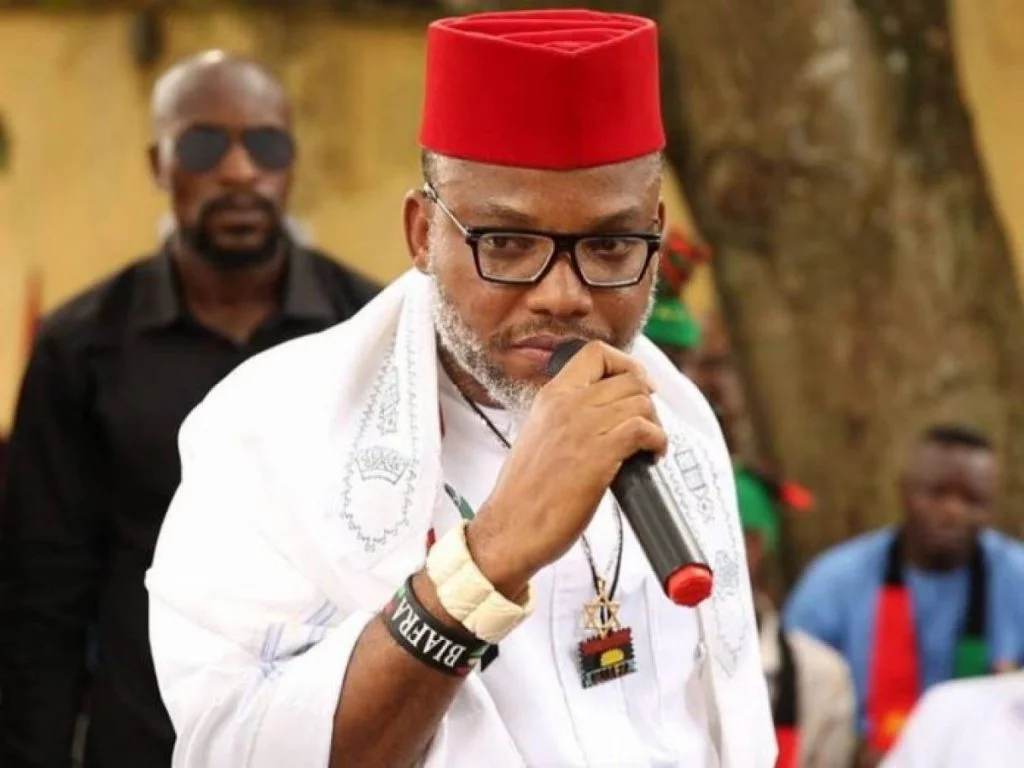
After years of high-profile legal battles, the Federal High Court in Abuja on Thursday began delivering judgment in the terrorism case involving Nnamdi Kanu, leader of the proscribed Indigenous People of Biafra (IPOB). The case, which has spanned a decade with multiple controversies, reached a turning point as the court pronounced him guilty on the first two counts of the amended charges.
Kanu, first arrested in 2015, faced allegations of treasonable felony and terrorism. His trial took several twists, including his 2017 flight from Nigeria after a military raid on his home during “Operation Python Dance,” and his controversial 2021 arrest in Kenya—an act his lawyers and supporters describe as “extraordinary rendition.” The charges were later expanded to 15, with prosecutors accusing him of inciting violence and issuing threats through broadcasts.
Throughout the proceedings, Kanu consistently challenged the court’s jurisdiction, arguing procedural violations and constitutional breaches. Despite this, the trial progressed with Adegboyega Awomolo, SAN, representing the Federal Government, while Kanu chose to represent himself.
Tensions escalated in court on Thursday as Justice Omotosho complained repeatedly about Kanu’s conduct, describing him as aggressive and unruly. The judge ordered him removed from the courtroom after he refused to surrender a microphone and continued interrupting proceedings, insisting he had pending applications the court must address before judgment.
Justice Omotosho ruled that the judgment would be delivered in Kanu’s absence, stressing that “nobody is above the law.”
Shortly after 1 p.m., the court found Kanu guilty on Count One and Count Two.
Count One involved allegations that Kanu committed an act of terrorism by issuing broadcasts threatening deaths and widespread chaos. The judge held that unchallenged prosecution evidence showed he made the threats and initiated actions that amounted to preparatory acts of terrorism. “He had the duty to explain himself but failed to do so,” the court ruled.
The judge also noted that prosecution evidence linked Kanu to the sit-at-home orders enforced across the South-East, saying he failed to respond to those allegations or call any witnesses in his defence. “I begged the defendant passionately to enter his defence, but he refused,” Justice Omotosho said.
Earlier in the day, Kanu had argued he did not jump bail, accused the government of detaining him on “non-existent charges,” and urged the court to grant him bail based on concurrent rulings of superior courts. He also listed several motions he claimed to have filed, including an application seeking referral of constitutional issues to the Court of Appeal.
Awomolo, however, asked the court to dismiss the bail request for lacking merit, saying no counter-affidavit was necessary.
Despite Kanu’s protests, the court maintained that hearing had been concluded and judgment would proceed.
More rulings on the remaining counts are expected as the court continues delivering its decision.